Showing posts with label Theresa May. Show all posts

Wednesday, December 12, 2018

How Do You Solve A Problem Like Theresa?

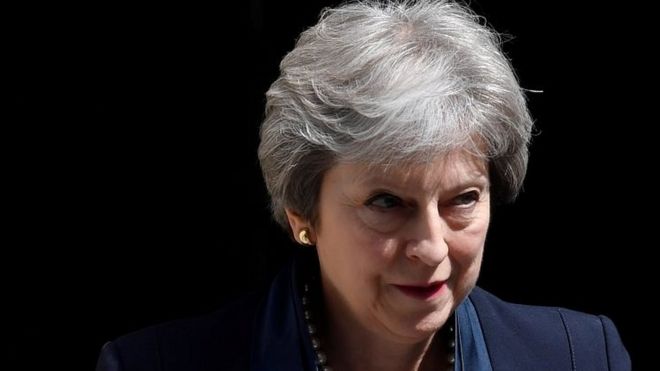
In one of the better villain lines of cinematic history, James Mason’s character in North By Northwest describes a troublesome adversary as “a matter best disposed of at a great height ... over water”. Would that this expedient solution was available to the Conservative Party which - having missed many opportunities during Theresa May’s Humiliation Tour of Europe over recent months - now faces the ghastly prospect of a Vote Of Confidence.

Events are moving fast; even given the normally ephemeral nature of blogging, Sordel sets finger to keyboard knowing that suspense will be brief and the matter largely settled either today or shortly thereafter. Yet, so rich & aromatic is this smoke for the connoisseur of game theory that it is irrestistable to draw it in and linger over it for a moment before breathing it back into the air to be lost forever.

In terms of tactics nothing should be more simple. The Prime Minister clearly does not carry the confidence of her party. No fewer than a hundred were expected to vote against her Brexit deal had she not put the motion back in her pocket and walked away whistling. If a hundred would oppose in public, it's a reasonable guess that others would oppose given the luxury of a secret ballot. On paper, Brexiters (whose letters largely, if not exclusively, triggered the vote) should vote against her. Remainers should vote against her.

Yet behind these seemingly straightforward decisions there is a lot for a Tory to ponder. Moderate Remainers and Brexiters could probably rally around the current deal to avoid the possibilities of No Deal or a so-called “People’s Vote” (which is just another referendum only this time made less threatening to anyone intimidated by four-syllable words). Hardline Brexiters have to weigh the possibility of wielding the knife yet losing the crown. And noisy Remainers face the exquisite paradox that although they are very keen to extend a vote to the country in general, they are genuinely terrified of putting a choice to their own party membership, who are very likely to impose a Brexiter leader should the vote fall to a free choice between a candidate from one of the party’s two extreme wings.

So although Conservative MPs don’t back Theresa May, there can be very little appetite to remove her. If she wins the vote, she is entitled to stay as leader: she cannot be challenged again for twelve months.

This is the key problem.

For while the parliamentary party might be happy to leave her in place severely wounded, there can be no delight anywhere at the prospect of giving her security of tenure until after Brexit. Unfortunately for her, the Prime Minister is not at all trusted by either wing: putting the Union in jeopardy has alienated even the somewhat Brexit-agnostic to her right; pulling the vote and humiliating the party has enflamed the paranoia of those to her Left to such an extent that it is widely suspected that she is engineering a stealth No Deal. Should either mistrust prove founded, there would be the numbers to support an opposition-led No Confidence vote, but that would be the only way to remove her and they would have to face a General Election whose result is highly uncertain.

The twelve-month moritorium on further votes was introduced to give the leader some security again endless Votes of Confidence, but it may prove to the decisive factor in unseating Mrs. May. A calculating Tory MP on the Remain side might rationally conclude that keeping her in place is hardly worse than having even the most loathed Brexiter in her place. (Indeed, there is a reasonable argument for saying that a loathed Brexiter in her place might be very good for a Remainer, giving considerable cover for moves against future government motions.)

When neither wing has a possible route to victory, it hardly matters what the result is, and that's how Mrs. May got the job in the first place.

[Image copyright: Reuters]


Wednesday, June 14, 2017

The Prisoners of Number Ten

The problem for the Conservative Party is not that it won too few seats, but that it won too many.

Being out of office for a political party is an occupational hazard and in some respects one of those healthy burns that Nature uses to keep a forest growing. Had the Conservatives lost, they could have taken Theresa May out back with that 12-bore reserved for the purpose, and cleanly begun the task of replacing her with a new leader. Boris, encouraged by the thought of years jeering from the Opposition benches at the hapless Corbyn, would joyfully come off the bench, affording both the Tories and the General Public great entertainment without anyone having to risk giving him any actual responsibility.

Moreover, not being in government would be something of a gift right now. Tories on both the Remain & Leave sides could come together to make common cause in criticising whatever slim pickings a Labour government might be able to secure from the EU by way of Brexit settlement. All the problems that currently fall to them would be pushed off onto Labour.

Were Corbyn to underperform against the high standards that he has set himself (as he surely would) he would disappoint the hopes of his younger supporters who would - like every starry-eyed generation of dreamers before them - become cynical inactivists. As it is, they will continue to support Labour in opposition, building a head of steam for the moment when he gets his next chance.

Due to their inconvenient success, the Tories can obtain none of the benefits of second place. Since neither Boris (nor anyone else) wants to lead a minority government tasked with impossible and critical negotiations with the EU, it will be very difficult to replace Theresa May. They are saddled with a lame duck leader who got the job because no one wanted it and will now keep it for precisely the same reason. How long they can tolerate the sight of her limping on with shattered authority is very questionable: John Major pulled it off with some aplomb, but Theresa May is nothing like John Major.

Worse, Tory hands are completely tied: if they opt for a soft Brexit they will be pilloried by their own Eurosceptics & eventually face a General Election at which the votes of former UKIP voters will bleed away; if they opt for a hard Brexit they will be defeated by a grand coalition of the Remainers.

The Tories felt that another period of government would be their reward but it is becoming increasingly obvious that it is actually their punishment.

Wednesday, June 7, 2017

The Last Gasp

Compared with the EU Referendum the 2017 UK General Election has been conducted in a spirit of considerable decorum. But then, compared to the EU Referendum, The Jeremy Kyle Show is conducted in a spirit of considerable decorum.

The Conservatives had two ideas at the outset: Jeremy Corbyn can't be trusted with the Brexit negotiations; and, Jeremy Corbyn can't be trusted. (It's one idea really.) In terms of positive campaigning, we have Theresa May's proud adoption of the "bloody difficult woman" nickname (an equivocal compliment at best) and her eleventh hour promise to do away with some of those pesky human rights. Otherwise, the strategy was to keep reminding people that the "leader" of the Labour Party is someone that the Great British Public already dislikes. If Corbyn is unthinkable then May is inevitable.

More significantly, the attacks on Corbyn have largely been matters of fact & record. He's opposed to the use of nuclear weapons and would not authorise a retaliatory strike. He is a Republican sympathiser (both Irish and, for that matter, English) and does not condemn the IRA. He is anti-Israeli and more comfortable than is entirely proper in the company of some of Israel's extremist enemies. He is ideologically wedded to a significant expansion of government spending based on tax-raising calculations that are at best back-of-envelope guesstimates. While Boris Johnson certainly went too far in describing Corbyn as a "friend of Britain's enemies" who "opposed shoot-to-kill" you can say quite a lot against Corbyn without actually having to make stuff up.

Yet precisely because Corbyn is seemingly willing to stand by so many of his past statements, it makes it difficult to use other innuendoes against him. Corbyn is opposed to "shoot-to-kill" in the sense of state-authorised assassination, but he has been unambiguous in his approval of the use of lethal force against terrorists during an incident. He opposes Israel but condemns anti-Semitism: some regard that as an implausible distinction but he doesn't seem to be lying.

On the other hand, there is too much that we don't know about May. Her stated policies - taking apart human rights legislation, taking away free lunches in primary schools, charging directly for social care provision - are, frankly, the stuff of The Left's most paranoid nightmares, yet these are the very measures which the Conservatives hope will enthrall your vote. Not to mention the free vote that they are offering on fox hunting: Sordel doesn't have strong feelings about that one, but it's hardly the most pressing business to which Commons time might be devoted.

Looking at Theresa May it's difficult to argue with the feeling that she has run a "Hillary Clinton" campaign: assuming that she will be elected on the basis that she is clearly the lesser of two evils without offering any sort of social vision around which voters can rally. Public approval of Mrs. May was tepid at the outset: she will be breaking ice to swim in it now.

Whoever wins this week there are dark days ahead since neither Labour (consistently behind in the polls & with an ungovernable parliamentary party) nor the Conservatives (with a badly wounded leader & recovering from a nasty scare in terms of their poll decline) are in the best shape to govern Britain.

On balance, it seems that the most likely winner of this election will be the E.U.

Wednesday, May 17, 2017

The Blame Game

The Independent had some interesting results on public opinion regarding the party leaders. The idea was to compare how much of a net drag the leader's popularity was on the party. Theresa May scored a healthy +6%: of those who liked either her or her party, more liked her than liked her party. Jeremy Corbyn, in marked contrast, scored -24%: of those who liked him or his party, far more liked his party than liked him.

If you were planning the campaign for the Conservative Party, you would probably push May into the spotlight, and this is of course what the Conservatives have done. As campaign planner for the Labour Party you would probably bind & gag Corbyn and lock him in a broom cupboard, yet Labour has also pushed Corbyn into prominence: he, Diane Abbott & John McDonnell have become the three-faced goddess of the Labour campaign.

Partly this is probably recognition from the party leadership that if Corbyn doesn't speak for himself then none of the moderates are likely to speak on his behalf. But it also seems highly likely that the Parliamentary Labour Party - seeing inevitable & swift defeat racing towards them - is isolating Corbyn so that he can become the scapegoat of their collective failure.

Unfortunately for them, this may backfire.

Corbyn cannot win this election, but to a certain extent he doesn't need to. Since the election was announced, Labour has stubbornly risen in the polls from a low point of 24% (probably an outlier) to a high of 32%. Even allowing for errors and the fact that Labour historically performs better in polls than elections, that suggests a 5% rise against a very popular government during a period when most Labour MPs have either been sitting on their hands or publicly saying that Corbyn is poison on the doorstep.

Moreover, the visuals of the campaign are playing into Corbyn's hands. The Prime Minister, attempting to sit on her lead and disinclined to take any risks, has thus far underperformed to what in another election would be an alarming degree. So far, the stories about Theresa May have been about an unconvincing performance as human being on The One Show and an attempt to eat chips sponsored by Photoshop. Her disciplined focus on the phrase strong and stable (which will probably help to win her the election but does nothing to endear her to journalists) only reinforces an impression of tedious stolidity.

Corbyn, however, has made some running. Appearing to cheering crowds of the faithful, he has reinforced the impression that those who like him do so less grudgingly than May's supporters. The likelihood of a landslide against Labour is now all but discounted: Corbyn could come away with a win by showing a roughly equivalent performance to Ed Miliband, which is what current predictions suggest will happen.

After all, there is a lot in this election that is not Corbyn's fault. He cannot be held to account for the collapse of UKIP or the good will currently extended to Theresa May by those who backed Brexit. He's hardly responsible for the fact that the Liberal Democrats (last bastion of the self-proclaimed 48%) are languishing at a dismal 8% of the vote in current predictions. It's difficult to see what he could have done to strengthen Labour in Scotland, where the battle lines seem to have been drawn on The Union & the EU.

It's not entirely impossible that both of the antagonists in this gladiatorial competition will come away with a win.

And whom will Labour MPs (such that remain) blame then?

Wednesday, May 3, 2017

Ghosts of the Barely Civil Undead

If the media consensus is to be believed the UK currently finds itself in middle of an election campaign that has been greeted with public apathy. Presumably, voters are bored for the same reason that shooting fish in a barrel never caught on as a spectator sport: rather than sportingly let her opponents get a head start in the renewed race for number ten, Theresa May called the election when she already had a considerable poll lead.

Unfortunately, bored journalists looking to make a story out of nothing have two sources of potential headlines close at hand: Tony Blair & George Osborne.

Blair's so-called return to politics is, of course, nothing of the sort. He has been a constant feature of the political landscape for the last year: he campaigned against both the Brexit side of referendum & Jeremy Corbyn's leadership of the Labour with all the determination of a man who has been on the wrong side of public opinion before and will be damned if he doesn't place himself on the wrong side of it again. Blair is not so much back as ever with us like the poor, and that era of foreign wars of which he was a principal architect.

Osborne, on the other hand, has been licking his wounds since last July. He is a man with a very particular claim to fame, having lead a campaign that failed to secure a Remain vote in the referendum despite having all three governing parties (&, for that matter, the SNP) on his side. As if that failure was not feather enough in his cap he is then reputed to have attempted to have May removed from her post at the Home Office as punishment for her failure to support his campaign more full-throatedly, laying the ground for a splendid reversal of fortunes of the sort more usually found in Game of Thrones.

Last September, it was reported that Osborne was attempting to cast himself as "the Tory opposition to Hard Brexit" and "revealed" that he was "considering a return to front line politics". All very "Tony Blair", who has been threatening something similar in an attempt to hold the media spotlight.

Now, however, Osborne has availed himself of a pulpit somewhat different from the anonymity of the back benches, as he has become the editor of the London Evening Standard, a paper that was described at one point as "a mouthpiece of the Conservative Party" but which has now recovered some measure of independence by trashing May's campaign (by no means unfairly) for its reliance on sloganeering above policy detail.

So here we have two senior politicians - both, in some measure, great successes & stupefying failures - who have decided to bring the force of their debatable insight to bear upon the leaders of their respective parties. Blair is trying to work up some enthusiasm for tactical voting & a progressive alliance; Osborne is sniping at the woman who sacked him, arguably in the hope that he can speed the Wheel of Fortune's inevitable turn towards the moment when he can inherit the party to which he is currently showing disputable loyalty.

Yet neither of these men wishes to serve. They airily speak of returning to politics, but not the politics of constituency surgeries, just the politics of enjoying an unelected vantage point for commentary. They are perfect representatives of the political class that played duck & cover when the EU referendum backfired: the class of which Boris and Cameron are also such perfect examples. They know all about cars just as long as they are kicking someone else's tyres.

And when it comes to unelected vantage points for commentary, the line forms behind Sordel.