There’s a stereotype about male drivers that they would rather drive twenty miles in the wrong direction than stop and check a map. Broadly speaking, this is what happened in the UK General Election. Despite the fact that there is considerable evidence that a majority of the electorate believes that the Brexit referendum came to the wrong decision (neither a “stonking” majority, nor a “thumping” one, but a majority nonetheless) UK voters made the net decision to drive on down the road in the hope that they would either locate a convenient and well-signposted junction on which to change direction or, better, would discover that they were on the right road all along.
What this means is that the issue of Brexit has been settled for a generation. (That's about eighteen months if you live North of the border.) What will they all argue about now?
It seems that the Labour Party is going to be riven (at least for the three months that it will take them to coalesce jubilantly around a new leader) by the question of what is to blame for its ignominious defeat. The analysis from the Left (for how could it be otherwise) is that the party was effectively run down in the street: it had been minding its own business, embracing ideals that were being warmly endorsed by the population in general, when it was brutally mown down by the issue of Brexit.
Labour Centrists, on the other hand, argue that holding a Marxist rally in middle of the South Circular was asking for trouble in the first place. A muddled message on Brexit was as nothing to the suspicion with which Corbyn himself was viewed by “traditional Labour voters”.
There’s room for both sides to be correct.
The sunny days of Corbyn’s Indian Summer, when he gambolled at festivals in the company of gaggles of doe-eyed supporters, seemed already long past when this election was called. He had done little enough to earn their adulation in the first place and little enough to estrange it in the last two years. It was just gone.
Certainly there was still enthusiasm for Corbyn, but it was the grim resolve of Jonestown rather than the febrile tunnel vision of a popular mass movement. The “Youthquake” had moved on to Extinction Rebellion with a more direct means of expression than the quiet anonymity of the ballot box.
Boris’s advantage was not that he was easy to like but that he was difficult to hate. Many managed to do so but nowhere near enough. It’s difficult to associate the image of a racist, sexist hard-Right politician with the photo ops that he gave in a fishmarket or delivering milk. Boris’s lies were legion, but they appeared, somehow, to be little white lies.
Corbyn’s truths were also legion, but they were great big scary truths full of class envy & social division. There was much in them with which voters widely sympathise, but ideals such as Corbyn’s are perhaps best viewed through the prism of a more pragmatic leader.
Finally, a word about Jo Swinson, the “blink and you missed her” leader of the Liberal Democrats. She has never appeared before in these pages as a label, nor is she likely to do so in the future, but there was something bitterly unfair about her constituency defeat. Her candid & straightforward approach to politics was a refreshing alternative to the cynicism of the Right and the fanaticism of the Left. This is one nutshell, however, where the middle of the road is a bad place to be.
Showing posts with label Conservative Party. Show all posts
Monday, December 16, 2019
Thursday, September 26, 2019
Boris Treads The Boards
The Commons (currently of no practical use as a place where the country's laws are written) has reverted to its alternative use as a theatre. When a theatre goes dark it does so in the expectation that a bold new production is in preparation. That is what our freshman Prime Minister managed to deliver yesterday.
As it turns out, we could have all saved ourselves the trouble of learning the word prorogation because The Supreme Court decided that Boris’s attempt to prorogue parliament was void. Consequently Boris was now up before the Beak: dragged back to the Commons to be served with as many of the best as UK MPs could deliver before their arms got tired. And none of them looked like their arms were going to get tired any time soon.
This was make or break for Johnson. His one & only Question Time - during which his bumbling delivery sounded rather clueless in the chamber - had not gone well. That, mind you, was before the highest court in the land had ruled that he had broken the law. Media coverage the day before had depicted this as a humiliating defeat and, worse, the Queen (talismanic to the majority of Conservative voters) had been caught in the crossfire, threatening to divide the government's core supporters. But early notice was given that the show might run as expected when Attorney General Geoffrey Cox gave a surprisingly feisty performance at the matinée. Like or loathe his manner (which is not so much that of a great barrister as that of a ham actor playing a great barrister) Cox steadied the ship, giving the Tories something to cheer about with more heartfelt sincerity than most of them can have thought possible.
The set piece debate that Johnson opened with a statement on the legal ruling was meant to go like this. Opposition MP after MP was lined up to say, again & again, that he had been found to have “mislead the people” by a “unanimous” decision of the court, was “unfit for office” and would, “if he had any shame” resign. This basic template was only varied by the SNP, who mixed in other sentiments in keeping with their nation's long cherished desire for liberty.
None of this needed to be said for the purposes of proceedings in parliament: it was all designed to send a message as many times as possible to television viewers. As such, like so many Commons deliberations, it was all hot air, if rather hotter than usual.
Johnson came back with a debater's trick: the Supreme Court judgement was a sideshow & in his opinion wrong ... the real issue was Brexit. And, surprisingly, it worked. Many opposition MPs, attracted both by the shiny word Brexit and the Prime Minister's gall in criticising the judgement, started responding to his narrative instead of following the agreed script. They were supposed to be furious about one thing ... now they were being furious about something else, or perhaps everything.
Then Johnson unleashed the phrase “Surrender bill” which has been kicking around for a while: it's like a nickname that the unpopular boy at school keeps using in the hope that everyone else will think it's as clever as he does. And, amazingly, the fish bit down hard on this unpromising bait. MP after MP stood up to say that it was quite improper, and probably dangerous, to describe a piece of legislation that had been written into law as a “surrender bill”. At which Boris would neatly reply that it certainly was a surrender bill, or capitulation bill if you prefer. Terms that had never had much currency before were suddenly being used on both sides of the House. And the angrier the Opposition got, the more strident they got while Johnson (after a couple of veiled but unambiguous appeals from the Speaker) dropped into a conciliatory tone, looking reasonable and - it has to be said - rather pleased with himself.
Boris had lost the judgement and won the debate.
Sordel says “won the debate” not “won the argument”. Many people, perhaps most people, will feel that Boris's bad guy act (especially on the subject of Jo Cox) was in poor taste and his thespian artistry was nothing more than Public School playacting, far removed from national concerns of pressing importance. But if this parliament has nothing to legislate - if it is essentially a bear pit in which the most vicious rhetorician prevails - then Boris managed to turn the tables on his opponents. They will consider their strategy more carefully before giving him hours at the despatch box next time.
The opposition emerged bloodied from the encounter: none more so than Jeremy Corbyn, who looked ashen when Nigel Dodds reminded a silent house that the Labour leader's new-found respect for the Rule of Law came too late for judges murdered by the IRA. Politicians who had sued for the right to recall parliament must have ended the day bitterly regretting their victory. As so many disinterested onlookers must do.
If this Boris show is not swiftly shuttered it may run & run.
(Illustration copyright Simon Haynes. Ironically it is reproduced from an article from July 2018 on whether that month would finally see the end of Boris Johnson.)
As it turns out, we could have all saved ourselves the trouble of learning the word prorogation because The Supreme Court decided that Boris’s attempt to prorogue parliament was void. Consequently Boris was now up before the Beak: dragged back to the Commons to be served with as many of the best as UK MPs could deliver before their arms got tired. And none of them looked like their arms were going to get tired any time soon.
This was make or break for Johnson. His one & only Question Time - during which his bumbling delivery sounded rather clueless in the chamber - had not gone well. That, mind you, was before the highest court in the land had ruled that he had broken the law. Media coverage the day before had depicted this as a humiliating defeat and, worse, the Queen (talismanic to the majority of Conservative voters) had been caught in the crossfire, threatening to divide the government's core supporters. But early notice was given that the show might run as expected when Attorney General Geoffrey Cox gave a surprisingly feisty performance at the matinée. Like or loathe his manner (which is not so much that of a great barrister as that of a ham actor playing a great barrister) Cox steadied the ship, giving the Tories something to cheer about with more heartfelt sincerity than most of them can have thought possible.
The set piece debate that Johnson opened with a statement on the legal ruling was meant to go like this. Opposition MP after MP was lined up to say, again & again, that he had been found to have “mislead the people” by a “unanimous” decision of the court, was “unfit for office” and would, “if he had any shame” resign. This basic template was only varied by the SNP, who mixed in other sentiments in keeping with their nation's long cherished desire for liberty.
None of this needed to be said for the purposes of proceedings in parliament: it was all designed to send a message as many times as possible to television viewers. As such, like so many Commons deliberations, it was all hot air, if rather hotter than usual.
Johnson came back with a debater's trick: the Supreme Court judgement was a sideshow & in his opinion wrong ... the real issue was Brexit. And, surprisingly, it worked. Many opposition MPs, attracted both by the shiny word Brexit and the Prime Minister's gall in criticising the judgement, started responding to his narrative instead of following the agreed script. They were supposed to be furious about one thing ... now they were being furious about something else, or perhaps everything.
Then Johnson unleashed the phrase “Surrender bill” which has been kicking around for a while: it's like a nickname that the unpopular boy at school keeps using in the hope that everyone else will think it's as clever as he does. And, amazingly, the fish bit down hard on this unpromising bait. MP after MP stood up to say that it was quite improper, and probably dangerous, to describe a piece of legislation that had been written into law as a “surrender bill”. At which Boris would neatly reply that it certainly was a surrender bill, or capitulation bill if you prefer. Terms that had never had much currency before were suddenly being used on both sides of the House. And the angrier the Opposition got, the more strident they got while Johnson (after a couple of veiled but unambiguous appeals from the Speaker) dropped into a conciliatory tone, looking reasonable and - it has to be said - rather pleased with himself.
Boris had lost the judgement and won the debate.
Sordel says “won the debate” not “won the argument”. Many people, perhaps most people, will feel that Boris's bad guy act (especially on the subject of Jo Cox) was in poor taste and his thespian artistry was nothing more than Public School playacting, far removed from national concerns of pressing importance. But if this parliament has nothing to legislate - if it is essentially a bear pit in which the most vicious rhetorician prevails - then Boris managed to turn the tables on his opponents. They will consider their strategy more carefully before giving him hours at the despatch box next time.
The opposition emerged bloodied from the encounter: none more so than Jeremy Corbyn, who looked ashen when Nigel Dodds reminded a silent house that the Labour leader's new-found respect for the Rule of Law came too late for judges murdered by the IRA. Politicians who had sued for the right to recall parliament must have ended the day bitterly regretting their victory. As so many disinterested onlookers must do.
If this Boris show is not swiftly shuttered it may run & run.
(Illustration copyright Simon Haynes. Ironically it is reproduced from an article from July 2018 on whether that month would finally see the end of Boris Johnson.)
Labels:
Boris Johnson,
Brexit,
Conservative Party,
Jeremy Corbyn,
Parliament
Wednesday, December 12, 2018
How Do You Solve A Problem Like Theresa?
In one of the better villain lines of cinematic history, James Mason’s character in North By Northwest describes a troublesome adversary as “a matter best disposed of at a great height ... over water”. Would that this expedient solution was available to the Conservative Party which - having missed many opportunities during Theresa May’s Humiliation Tour of Europe over recent months - now faces the ghastly prospect of a Vote Of Confidence.
Events are moving fast; even given the normally ephemeral nature of blogging, Sordel sets finger to keyboard knowing that suspense will be brief and the matter largely settled either today or shortly thereafter. Yet, so rich & aromatic is this smoke for the connoisseur of game theory that it is irrestistable to draw it in and linger over it for a moment before breathing it back into the air to be lost forever.
In terms of tactics nothing should be more simple. The Prime Minister clearly does not carry the confidence of her party. No fewer than a hundred were expected to vote against her Brexit deal had she not put the motion back in her pocket and walked away whistling. If a hundred would oppose in public, it's a reasonable guess that others would oppose given the luxury of a secret ballot. On paper, Brexiters (whose letters largely, if not exclusively, triggered the vote) should vote against her. Remainers should vote against her.
Yet behind these seemingly straightforward decisions there is a lot for a Tory to ponder. Moderate Remainers and Brexiters could probably rally around the current deal to avoid the possibilities of No Deal or a so-called “People’s Vote” (which is just another referendum only this time made less threatening to anyone intimidated by four-syllable words). Hardline Brexiters have to weigh the possibility of wielding the knife yet losing the crown. And noisy Remainers face the exquisite paradox that although they are very keen to extend a vote to the country in general, they are genuinely terrified of putting a choice to their own party membership, who are very likely to impose a Brexiter leader should the vote fall to a free choice between a candidate from one of the party’s two extreme wings.
So although Conservative MPs don’t back Theresa May, there can be very little appetite to remove her. If she wins the vote, she is entitled to stay as leader: she cannot be challenged again for twelve months.
This is the key problem.
For while the parliamentary party might be happy to leave her in place severely wounded, there can be no delight anywhere at the prospect of giving her security of tenure until after Brexit. Unfortunately for her, the Prime Minister is not at all trusted by either wing: putting the Union in jeopardy has alienated even the somewhat Brexit-agnostic to her right; pulling the vote and humiliating the party has enflamed the paranoia of those to her Left to such an extent that it is widely suspected that she is engineering a stealth No Deal. Should either mistrust prove founded, there would be the numbers to support an opposition-led No Confidence vote, but that would be the only way to remove her and they would have to face a General Election whose result is highly uncertain.
The twelve-month moritorium on further votes was introduced to give the leader some security again endless Votes of Confidence, but it may prove to the decisive factor in unseating Mrs. May. A calculating Tory MP on the Remain side might rationally conclude that keeping her in place is hardly worse than having even the most loathed Brexiter in her place. (Indeed, there is a reasonable argument for saying that a loathed Brexiter in her place might be very good for a Remainer, giving considerable cover for moves against future government motions.)
When neither wing has a possible route to victory, it hardly matters what the result is, and that's how Mrs. May got the job in the first place.
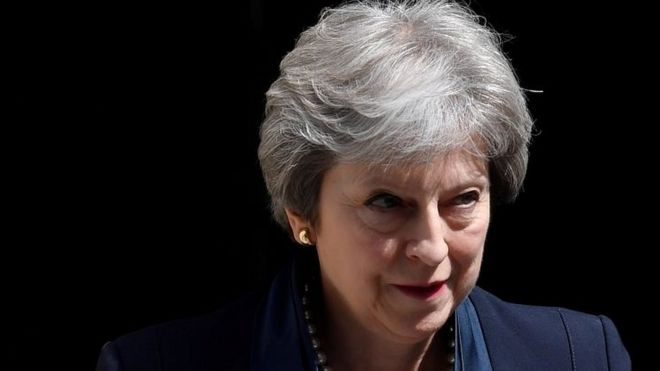
[Image copyright: Reuters]
Events are moving fast; even given the normally ephemeral nature of blogging, Sordel sets finger to keyboard knowing that suspense will be brief and the matter largely settled either today or shortly thereafter. Yet, so rich & aromatic is this smoke for the connoisseur of game theory that it is irrestistable to draw it in and linger over it for a moment before breathing it back into the air to be lost forever.
In terms of tactics nothing should be more simple. The Prime Minister clearly does not carry the confidence of her party. No fewer than a hundred were expected to vote against her Brexit deal had she not put the motion back in her pocket and walked away whistling. If a hundred would oppose in public, it's a reasonable guess that others would oppose given the luxury of a secret ballot. On paper, Brexiters (whose letters largely, if not exclusively, triggered the vote) should vote against her. Remainers should vote against her.
Yet behind these seemingly straightforward decisions there is a lot for a Tory to ponder. Moderate Remainers and Brexiters could probably rally around the current deal to avoid the possibilities of No Deal or a so-called “People’s Vote” (which is just another referendum only this time made less threatening to anyone intimidated by four-syllable words). Hardline Brexiters have to weigh the possibility of wielding the knife yet losing the crown. And noisy Remainers face the exquisite paradox that although they are very keen to extend a vote to the country in general, they are genuinely terrified of putting a choice to their own party membership, who are very likely to impose a Brexiter leader should the vote fall to a free choice between a candidate from one of the party’s two extreme wings.
So although Conservative MPs don’t back Theresa May, there can be very little appetite to remove her. If she wins the vote, she is entitled to stay as leader: she cannot be challenged again for twelve months.
This is the key problem.
For while the parliamentary party might be happy to leave her in place severely wounded, there can be no delight anywhere at the prospect of giving her security of tenure until after Brexit. Unfortunately for her, the Prime Minister is not at all trusted by either wing: putting the Union in jeopardy has alienated even the somewhat Brexit-agnostic to her right; pulling the vote and humiliating the party has enflamed the paranoia of those to her Left to such an extent that it is widely suspected that she is engineering a stealth No Deal. Should either mistrust prove founded, there would be the numbers to support an opposition-led No Confidence vote, but that would be the only way to remove her and they would have to face a General Election whose result is highly uncertain.
The twelve-month moritorium on further votes was introduced to give the leader some security again endless Votes of Confidence, but it may prove to the decisive factor in unseating Mrs. May. A calculating Tory MP on the Remain side might rationally conclude that keeping her in place is hardly worse than having even the most loathed Brexiter in her place. (Indeed, there is a reasonable argument for saying that a loathed Brexiter in her place might be very good for a Remainer, giving considerable cover for moves against future government motions.)
When neither wing has a possible route to victory, it hardly matters what the result is, and that's how Mrs. May got the job in the first place.
[Image copyright: Reuters]
Labels:
Brexit,
British Politics,
Conservative Party,
Theresa May,
Tory Party
Wednesday, June 14, 2017
The Prisoners of Number Ten
The problem for the Conservative Party is not that it won too few seats, but that it won too many.
Being out of office for a political party is an occupational hazard and in some respects one of those healthy burns that Nature uses to keep a forest growing. Had the Conservatives lost, they could have taken Theresa May out back with that 12-bore reserved for the purpose, and cleanly begun the task of replacing her with a new leader. Boris, encouraged by the thought of years jeering from the Opposition benches at the hapless Corbyn, would joyfully come off the bench, affording both the Tories and the General Public great entertainment without anyone having to risk giving him any actual responsibility.
Moreover, not being in government would be something of a gift right now. Tories on both the Remain & Leave sides could come together to make common cause in criticising whatever slim pickings a Labour government might be able to secure from the EU by way of Brexit settlement. All the problems that currently fall to them would be pushed off onto Labour.
Were Corbyn to underperform against the high standards that he has set himself (as he surely would) he would disappoint the hopes of his younger supporters who would - like every starry-eyed generation of dreamers before them - become cynical inactivists. As it is, they will continue to support Labour in opposition, building a head of steam for the moment when he gets his next chance.
Due to their inconvenient success, the Tories can obtain none of the benefits of second place. Since neither Boris (nor anyone else) wants to lead a minority government tasked with impossible and critical negotiations with the EU, it will be very difficult to replace Theresa May. They are saddled with a lame duck leader who got the job because no one wanted it and will now keep it for precisely the same reason. How long they can tolerate the sight of her limping on with shattered authority is very questionable: John Major pulled it off with some aplomb, but Theresa May is nothing like John Major.
Worse, Tory hands are completely tied: if they opt for a soft Brexit they will be pilloried by their own Eurosceptics & eventually face a General Election at which the votes of former UKIP voters will bleed away; if they opt for a hard Brexit they will be defeated by a grand coalition of the Remainers.
The Tories felt that another period of government would be their reward but it is becoming increasingly obvious that it is actually their punishment.
Being out of office for a political party is an occupational hazard and in some respects one of those healthy burns that Nature uses to keep a forest growing. Had the Conservatives lost, they could have taken Theresa May out back with that 12-bore reserved for the purpose, and cleanly begun the task of replacing her with a new leader. Boris, encouraged by the thought of years jeering from the Opposition benches at the hapless Corbyn, would joyfully come off the bench, affording both the Tories and the General Public great entertainment without anyone having to risk giving him any actual responsibility.
Moreover, not being in government would be something of a gift right now. Tories on both the Remain & Leave sides could come together to make common cause in criticising whatever slim pickings a Labour government might be able to secure from the EU by way of Brexit settlement. All the problems that currently fall to them would be pushed off onto Labour.
Were Corbyn to underperform against the high standards that he has set himself (as he surely would) he would disappoint the hopes of his younger supporters who would - like every starry-eyed generation of dreamers before them - become cynical inactivists. As it is, they will continue to support Labour in opposition, building a head of steam for the moment when he gets his next chance.
Due to their inconvenient success, the Tories can obtain none of the benefits of second place. Since neither Boris (nor anyone else) wants to lead a minority government tasked with impossible and critical negotiations with the EU, it will be very difficult to replace Theresa May. They are saddled with a lame duck leader who got the job because no one wanted it and will now keep it for precisely the same reason. How long they can tolerate the sight of her limping on with shattered authority is very questionable: John Major pulled it off with some aplomb, but Theresa May is nothing like John Major.
Worse, Tory hands are completely tied: if they opt for a soft Brexit they will be pilloried by their own Eurosceptics & eventually face a General Election at which the votes of former UKIP voters will bleed away; if they opt for a hard Brexit they will be defeated by a grand coalition of the Remainers.
The Tories felt that another period of government would be their reward but it is becoming increasingly obvious that it is actually their punishment.
Wednesday, June 7, 2017
The Last Gasp
Compared with the EU Referendum the 2017 UK General Election has been conducted in a spirit of considerable decorum. But then, compared to the EU Referendum, The Jeremy Kyle Show is conducted in a spirit of considerable decorum.
The Conservatives had two ideas at the outset: Jeremy Corbyn can't be trusted with the Brexit negotiations; and, Jeremy Corbyn can't be trusted. (It's one idea really.) In terms of positive campaigning, we have Theresa May's proud adoption of the "bloody difficult woman" nickname (an equivocal compliment at best) and her eleventh hour promise to do away with some of those pesky human rights. Otherwise, the strategy was to keep reminding people that the "leader" of the Labour Party is someone that the Great British Public already dislikes. If Corbyn is unthinkable then May is inevitable.
More significantly, the attacks on Corbyn have largely been matters of fact & record. He's opposed to the use of nuclear weapons and would not authorise a retaliatory strike. He is a Republican sympathiser (both Irish and, for that matter, English) and does not condemn the IRA. He is anti-Israeli and more comfortable than is entirely proper in the company of some of Israel's extremist enemies. He is ideologically wedded to a significant expansion of government spending based on tax-raising calculations that are at best back-of-envelope guesstimates. While Boris Johnson certainly went too far in describing Corbyn as a "friend of Britain's enemies" who "opposed shoot-to-kill" you can say quite a lot against Corbyn without actually having to make stuff up.
Yet precisely because Corbyn is seemingly willing to stand by so many of his past statements, it makes it difficult to use other innuendoes against him. Corbyn is opposed to "shoot-to-kill" in the sense of state-authorised assassination, but he has been unambiguous in his approval of the use of lethal force against terrorists during an incident. He opposes Israel but condemns anti-Semitism: some regard that as an implausible distinction but he doesn't seem to be lying.
On the other hand, there is too much that we don't know about May. Her stated policies - taking apart human rights legislation, taking away free lunches in primary schools, charging directly for social care provision - are, frankly, the stuff of The Left's most paranoid nightmares, yet these are the very measures which the Conservatives hope will enthrall your vote. Not to mention the free vote that they are offering on fox hunting: Sordel doesn't have strong feelings about that one, but it's hardly the most pressing business to which Commons time might be devoted.
Looking at Theresa May it's difficult to argue with the feeling that she has run a "Hillary Clinton" campaign: assuming that she will be elected on the basis that she is clearly the lesser of two evils without offering any sort of social vision around which voters can rally. Public approval of Mrs. May was tepid at the outset: she will be breaking ice to swim in it now.
Whoever wins this week there are dark days ahead since neither Labour (consistently behind in the polls & with an ungovernable parliamentary party) nor the Conservatives (with a badly wounded leader & recovering from a nasty scare in terms of their poll decline) are in the best shape to govern Britain.
On balance, it seems that the most likely winner of this election will be the E.U.
The Conservatives had two ideas at the outset: Jeremy Corbyn can't be trusted with the Brexit negotiations; and, Jeremy Corbyn can't be trusted. (It's one idea really.) In terms of positive campaigning, we have Theresa May's proud adoption of the "bloody difficult woman" nickname (an equivocal compliment at best) and her eleventh hour promise to do away with some of those pesky human rights. Otherwise, the strategy was to keep reminding people that the "leader" of the Labour Party is someone that the Great British Public already dislikes. If Corbyn is unthinkable then May is inevitable.
More significantly, the attacks on Corbyn have largely been matters of fact & record. He's opposed to the use of nuclear weapons and would not authorise a retaliatory strike. He is a Republican sympathiser (both Irish and, for that matter, English) and does not condemn the IRA. He is anti-Israeli and more comfortable than is entirely proper in the company of some of Israel's extremist enemies. He is ideologically wedded to a significant expansion of government spending based on tax-raising calculations that are at best back-of-envelope guesstimates. While Boris Johnson certainly went too far in describing Corbyn as a "friend of Britain's enemies" who "opposed shoot-to-kill" you can say quite a lot against Corbyn without actually having to make stuff up.
Yet precisely because Corbyn is seemingly willing to stand by so many of his past statements, it makes it difficult to use other innuendoes against him. Corbyn is opposed to "shoot-to-kill" in the sense of state-authorised assassination, but he has been unambiguous in his approval of the use of lethal force against terrorists during an incident. He opposes Israel but condemns anti-Semitism: some regard that as an implausible distinction but he doesn't seem to be lying.
On the other hand, there is too much that we don't know about May. Her stated policies - taking apart human rights legislation, taking away free lunches in primary schools, charging directly for social care provision - are, frankly, the stuff of The Left's most paranoid nightmares, yet these are the very measures which the Conservatives hope will enthrall your vote. Not to mention the free vote that they are offering on fox hunting: Sordel doesn't have strong feelings about that one, but it's hardly the most pressing business to which Commons time might be devoted.
Looking at Theresa May it's difficult to argue with the feeling that she has run a "Hillary Clinton" campaign: assuming that she will be elected on the basis that she is clearly the lesser of two evils without offering any sort of social vision around which voters can rally. Public approval of Mrs. May was tepid at the outset: she will be breaking ice to swim in it now.
Whoever wins this week there are dark days ahead since neither Labour (consistently behind in the polls & with an ungovernable parliamentary party) nor the Conservatives (with a badly wounded leader & recovering from a nasty scare in terms of their poll decline) are in the best shape to govern Britain.
On balance, it seems that the most likely winner of this election will be the E.U.
Wednesday, May 17, 2017
The Blame Game
The Independent had some interesting results on public opinion regarding the party leaders. The idea was to compare how much of a net drag the leader's popularity was on the party. Theresa May scored a healthy +6%: of those who liked either her or her party, more liked her than liked her party. Jeremy Corbyn, in marked contrast, scored -24%: of those who liked him or his party, far more liked his party than liked him.
If you were planning the campaign for the Conservative Party, you would probably push May into the spotlight, and this is of course what the Conservatives have done. As campaign planner for the Labour Party you would probably bind & gag Corbyn and lock him in a broom cupboard, yet Labour has also pushed Corbyn into prominence: he, Diane Abbott & John McDonnell have become the three-faced goddess of the Labour campaign.
Partly this is probably recognition from the party leadership that if Corbyn doesn't speak for himself then none of the moderates are likely to speak on his behalf. But it also seems highly likely that the Parliamentary Labour Party - seeing inevitable & swift defeat racing towards them - is isolating Corbyn so that he can become the scapegoat of their collective failure.
Unfortunately for them, this may backfire.
Corbyn cannot win this election, but to a certain extent he doesn't need to. Since the election was announced, Labour has stubbornly risen in the polls from a low point of 24% (probably an outlier) to a high of 32%. Even allowing for errors and the fact that Labour historically performs better in polls than elections, that suggests a 5% rise against a very popular government during a period when most Labour MPs have either been sitting on their hands or publicly saying that Corbyn is poison on the doorstep.
Moreover, the visuals of the campaign are playing into Corbyn's hands. The Prime Minister, attempting to sit on her lead and disinclined to take any risks, has thus far underperformed to what in another election would be an alarming degree. So far, the stories about Theresa May have been about an unconvincing performance as human being on The One Show and an attempt to eat chips sponsored by Photoshop. Her disciplined focus on the phrase strong and stable (which will probably help to win her the election but does nothing to endear her to journalists) only reinforces an impression of tedious stolidity.
Corbyn, however, has made some running. Appearing to cheering crowds of the faithful, he has reinforced the impression that those who like him do so less grudgingly than May's supporters. The likelihood of a landslide against Labour is now all but discounted: Corbyn could come away with a win by showing a roughly equivalent performance to Ed Miliband, which is what current predictions suggest will happen.
After all, there is a lot in this election that is not Corbyn's fault. He cannot be held to account for the collapse of UKIP or the good will currently extended to Theresa May by those who backed Brexit. He's hardly responsible for the fact that the Liberal Democrats (last bastion of the self-proclaimed 48%) are languishing at a dismal 8% of the vote in current predictions. It's difficult to see what he could have done to strengthen Labour in Scotland, where the battle lines seem to have been drawn on The Union & the EU.
It's not entirely impossible that both of the antagonists in this gladiatorial competition will come away with a win.
And whom will Labour MPs (such that remain) blame then?
If you were planning the campaign for the Conservative Party, you would probably push May into the spotlight, and this is of course what the Conservatives have done. As campaign planner for the Labour Party you would probably bind & gag Corbyn and lock him in a broom cupboard, yet Labour has also pushed Corbyn into prominence: he, Diane Abbott & John McDonnell have become the three-faced goddess of the Labour campaign.
Partly this is probably recognition from the party leadership that if Corbyn doesn't speak for himself then none of the moderates are likely to speak on his behalf. But it also seems highly likely that the Parliamentary Labour Party - seeing inevitable & swift defeat racing towards them - is isolating Corbyn so that he can become the scapegoat of their collective failure.
Unfortunately for them, this may backfire.
Corbyn cannot win this election, but to a certain extent he doesn't need to. Since the election was announced, Labour has stubbornly risen in the polls from a low point of 24% (probably an outlier) to a high of 32%. Even allowing for errors and the fact that Labour historically performs better in polls than elections, that suggests a 5% rise against a very popular government during a period when most Labour MPs have either been sitting on their hands or publicly saying that Corbyn is poison on the doorstep.
Moreover, the visuals of the campaign are playing into Corbyn's hands. The Prime Minister, attempting to sit on her lead and disinclined to take any risks, has thus far underperformed to what in another election would be an alarming degree. So far, the stories about Theresa May have been about an unconvincing performance as human being on The One Show and an attempt to eat chips sponsored by Photoshop. Her disciplined focus on the phrase strong and stable (which will probably help to win her the election but does nothing to endear her to journalists) only reinforces an impression of tedious stolidity.
Corbyn, however, has made some running. Appearing to cheering crowds of the faithful, he has reinforced the impression that those who like him do so less grudgingly than May's supporters. The likelihood of a landslide against Labour is now all but discounted: Corbyn could come away with a win by showing a roughly equivalent performance to Ed Miliband, which is what current predictions suggest will happen.
After all, there is a lot in this election that is not Corbyn's fault. He cannot be held to account for the collapse of UKIP or the good will currently extended to Theresa May by those who backed Brexit. He's hardly responsible for the fact that the Liberal Democrats (last bastion of the self-proclaimed 48%) are languishing at a dismal 8% of the vote in current predictions. It's difficult to see what he could have done to strengthen Labour in Scotland, where the battle lines seem to have been drawn on The Union & the EU.
It's not entirely impossible that both of the antagonists in this gladiatorial competition will come away with a win.
And whom will Labour MPs (such that remain) blame then?
Wednesday, May 3, 2017
Ghosts of the Barely Civil Undead
If the media consensus is to be believed the UK currently finds itself in middle of an election campaign that has been greeted with public apathy. Presumably, voters are bored for the same reason that shooting fish in a barrel never caught on as a spectator sport: rather than sportingly let her opponents get a head start in the renewed race for number ten, Theresa May called the election when she already had a considerable poll lead.
Unfortunately, bored journalists looking to make a story out of nothing have two sources of potential headlines close at hand: Tony Blair & George Osborne.
Blair's so-called return to politics is, of course, nothing of the sort. He has been a constant feature of the political landscape for the last year: he campaigned against both the Brexit side of referendum & Jeremy Corbyn's leadership of the Labour with all the determination of a man who has been on the wrong side of public opinion before and will be damned if he doesn't place himself on the wrong side of it again. Blair is not so much back as ever with us like the poor, and that era of foreign wars of which he was a principal architect.
Osborne, on the other hand, has been licking his wounds since last July. He is a man with a very particular claim to fame, having lead a campaign that failed to secure a Remain vote in the referendum despite having all three governing parties (&, for that matter, the SNP) on his side. As if that failure was not feather enough in his cap he is then reputed to have attempted to have May removed from her post at the Home Office as punishment for her failure to support his campaign more full-throatedly, laying the ground for a splendid reversal of fortunes of the sort more usually found in Game of Thrones.
Last September, it was reported that Osborne was attempting to cast himself as "the Tory opposition to Hard Brexit" and "revealed" that he was "considering a return to front line politics". All very "Tony Blair", who has been threatening something similar in an attempt to hold the media spotlight.
Now, however, Osborne has availed himself of a pulpit somewhat different from the anonymity of the back benches, as he has become the editor of the London Evening Standard, a paper that was described at one point as "a mouthpiece of the Conservative Party" but which has now recovered some measure of independence by trashing May's campaign (by no means unfairly) for its reliance on sloganeering above policy detail.
So here we have two senior politicians - both, in some measure, great successes & stupefying failures - who have decided to bring the force of their debatable insight to bear upon the leaders of their respective parties. Blair is trying to work up some enthusiasm for tactical voting & a progressive alliance; Osborne is sniping at the woman who sacked him, arguably in the hope that he can speed the Wheel of Fortune's inevitable turn towards the moment when he can inherit the party to which he is currently showing disputable loyalty.
Yet neither of these men wishes to serve. They airily speak of returning to politics, but not the politics of constituency surgeries, just the politics of enjoying an unelected vantage point for commentary. They are perfect representatives of the political class that played duck & cover when the EU referendum backfired: the class of which Boris and Cameron are also such perfect examples. They know all about cars just as long as they are kicking someone else's tyres.
And when it comes to unelected vantage points for commentary, the line forms behind Sordel.
Unfortunately, bored journalists looking to make a story out of nothing have two sources of potential headlines close at hand: Tony Blair & George Osborne.
Blair's so-called return to politics is, of course, nothing of the sort. He has been a constant feature of the political landscape for the last year: he campaigned against both the Brexit side of referendum & Jeremy Corbyn's leadership of the Labour with all the determination of a man who has been on the wrong side of public opinion before and will be damned if he doesn't place himself on the wrong side of it again. Blair is not so much back as ever with us like the poor, and that era of foreign wars of which he was a principal architect.
Osborne, on the other hand, has been licking his wounds since last July. He is a man with a very particular claim to fame, having lead a campaign that failed to secure a Remain vote in the referendum despite having all three governing parties (&, for that matter, the SNP) on his side. As if that failure was not feather enough in his cap he is then reputed to have attempted to have May removed from her post at the Home Office as punishment for her failure to support his campaign more full-throatedly, laying the ground for a splendid reversal of fortunes of the sort more usually found in Game of Thrones.
Last September, it was reported that Osborne was attempting to cast himself as "the Tory opposition to Hard Brexit" and "revealed" that he was "considering a return to front line politics". All very "Tony Blair", who has been threatening something similar in an attempt to hold the media spotlight.
Now, however, Osborne has availed himself of a pulpit somewhat different from the anonymity of the back benches, as he has become the editor of the London Evening Standard, a paper that was described at one point as "a mouthpiece of the Conservative Party" but which has now recovered some measure of independence by trashing May's campaign (by no means unfairly) for its reliance on sloganeering above policy detail.
So here we have two senior politicians - both, in some measure, great successes & stupefying failures - who have decided to bring the force of their debatable insight to bear upon the leaders of their respective parties. Blair is trying to work up some enthusiasm for tactical voting & a progressive alliance; Osborne is sniping at the woman who sacked him, arguably in the hope that he can speed the Wheel of Fortune's inevitable turn towards the moment when he can inherit the party to which he is currently showing disputable loyalty.
Yet neither of these men wishes to serve. They airily speak of returning to politics, but not the politics of constituency surgeries, just the politics of enjoying an unelected vantage point for commentary. They are perfect representatives of the political class that played duck & cover when the EU referendum backfired: the class of which Boris and Cameron are also such perfect examples. They know all about cars just as long as they are kicking someone else's tyres.
And when it comes to unelected vantage points for commentary, the line forms behind Sordel.
Friday, June 24, 2016
Careful What You Wish For
Like participants in an especially hedonistic stag party, UK voters awakened today to the challenge of distinguishing reality from the ghastly fever dream that had troubled their sleep. A dawning realisation will be transferred from face to face as people pass one another on the street and look nervously away. By God, it's true, we did that.
That (for those tripping over this very small corner of the internet whilst looking for something else in years to come) is this: the UK voted to leave the EU. Yes, the Little Train That Couldn't, did, and it turns out that Casey Jones was at the engine, going full steam to catastrophe.
When many of us went to bed last night we did so in a markedly different world: Farage had reputedly conceded; David Dimbleby had announced that the pro-EU campaign seemed to have prevailed; and even the pro-Leave talking heads seemed to think that the issue had been settled for the status quo. This consensus, however, was based on the idea that a large turnout would favour Remain: a narrative that was at odds with what many were saying about the demographic of their supporters. If those who vote Remain are the most educated, metropolitan, Guardian-reading members of society, aren't these the people who reliably vote in every election? Who were these other people registering and voting in large numbers? Why was the assumption that people who took too little interest in politics to vote in a General Election were suddenly rallying to the flag of the European Union?
The reality of the matter - that the Leave campaign had prevailed on the basis of a massive turnout - has proven to be a national act of civil disobedience. The vice anglais was well-named: the British people has cast aside its safe word and asking to be whipped a little harder please Miss. We're often told in the political context that turkeys don't vote for Christmas, yet the UK electorate has basted itself, cooked itself to perfection and has a saucière of cranberry sauce balanced on its left wing.
Quite why that is we will probably never know because the votes that swung this referendum are not the votes that we could see (the active, UKIP-voting people of Middle England who could be heard on every radio debate prior to voting day) but the votes that we couldn't: the quiet, unannounced votes that tipped the balance.
But if you're looking around today for someone to blame in the weeks, months, perhaps years to come, it's worth bearing in mind that the referendum only took place due to a cynical piece of manoeuvring from the man who professed to want it least. David Cameron jeopardised (History may say "sacrificed") his entire nation solely to minimise the UKIP vote at the last General Election, promising a referendum that would/could never pass in a bid to cling to power. On the morning after the night before, he proved to be not the result's only - but certainly its most prominent - casualty.
If the poets have tragedies yet to write then let them ponder that.
That (for those tripping over this very small corner of the internet whilst looking for something else in years to come) is this: the UK voted to leave the EU. Yes, the Little Train That Couldn't, did, and it turns out that Casey Jones was at the engine, going full steam to catastrophe.
When many of us went to bed last night we did so in a markedly different world: Farage had reputedly conceded; David Dimbleby had announced that the pro-EU campaign seemed to have prevailed; and even the pro-Leave talking heads seemed to think that the issue had been settled for the status quo. This consensus, however, was based on the idea that a large turnout would favour Remain: a narrative that was at odds with what many were saying about the demographic of their supporters. If those who vote Remain are the most educated, metropolitan, Guardian-reading members of society, aren't these the people who reliably vote in every election? Who were these other people registering and voting in large numbers? Why was the assumption that people who took too little interest in politics to vote in a General Election were suddenly rallying to the flag of the European Union?
The reality of the matter - that the Leave campaign had prevailed on the basis of a massive turnout - has proven to be a national act of civil disobedience. The vice anglais was well-named: the British people has cast aside its safe word and asking to be whipped a little harder please Miss. We're often told in the political context that turkeys don't vote for Christmas, yet the UK electorate has basted itself, cooked itself to perfection and has a saucière of cranberry sauce balanced on its left wing.
Quite why that is we will probably never know because the votes that swung this referendum are not the votes that we could see (the active, UKIP-voting people of Middle England who could be heard on every radio debate prior to voting day) but the votes that we couldn't: the quiet, unannounced votes that tipped the balance.
But if you're looking around today for someone to blame in the weeks, months, perhaps years to come, it's worth bearing in mind that the referendum only took place due to a cynical piece of manoeuvring from the man who professed to want it least. David Cameron jeopardised (History may say "sacrificed") his entire nation solely to minimise the UKIP vote at the last General Election, promising a referendum that would/could never pass in a bid to cling to power. On the morning after the night before, he proved to be not the result's only - but certainly its most prominent - casualty.
If the poets have tragedies yet to write then let them ponder that.
Labels:
Bremain,
Brexit,
British Politics,
Conservative Party,
David Cameron,
David Dimbleby,
EU,
Nigel Farage,
Referendum,
UKIP
Tuesday, June 21, 2016
The Little Train That Couldn't
If you believe the mythology of these things, Neil Kinnock sunk Labour's chances of victory in the 1992 General Election at a rally in Sheffield where he uttered the deathless soundbite "We're alright!" The rally - which fittingly took place on April Fool's Day - is notable as being just about the last time in British political history that a politician ever made the mistake of showing spontaneous feeling at a conference podium. But the sentiment was at least positive.
Two days out from the EU Referendum, Sordel is ready to capitulate to the prevailing logic. Cameron has me convinced. The Department of Trade & Industry can't negotiate trade agreements. Countries investing in Britain are not after anything that we have to trade; they are primarily interested in our access to the Continental marketplace. Membership of NATO and the United Nations counts for nothing, and if you're pining for The Commonwealth, pine on Grandad. Britain cannot make it on its own, and certainly not with any of the likely potential pilots at the helm.
And this isn't sarcasm.
There is, admittedly, a positive argument for remaining in the EU. We're better inside helping shape the decisions than outside suffering the consequences of them. This affords the UK to effect genuine global change through multilateral action with European partners irrespective of their frankly waning power and relevance. None of that is wrong; people join exclusive clubs for a reason and they don't give up membership on a whim or without qualms.
But the positive logic is as nothing compared with the negative logic of staying in Europe. The UK didn't need an EU to shape international affairs in the past, but then it had leaders who would not have dreamed of devoting months of their time fighting a completely unnecessary referendum on the basis of the UK's fundamental weakness.
This is not party political sniping: Labour, Conservatives and Lib Dems (whatever happened to them?) are as one on this point. It can't be done, and - if it could - we can't do it.
Maybe some other UK with some other leader. Not this one. Not with Cameron, or Corbyn, or (let me check my notes) Tim Farron. Not with Boris Johnson, Nigel Farage or Michael Gove either, lest you think that Sordel dreams of princes across the sea.
If you can't trust your politicians, Brexit is too big a risk to take, which is why I cannot vote for it.
Cometh the Hour, Cometh the Slogan, and the slogan for these times is this: "We're All Wrong."
Two days out from the EU Referendum, Sordel is ready to capitulate to the prevailing logic. Cameron has me convinced. The Department of Trade & Industry can't negotiate trade agreements. Countries investing in Britain are not after anything that we have to trade; they are primarily interested in our access to the Continental marketplace. Membership of NATO and the United Nations counts for nothing, and if you're pining for The Commonwealth, pine on Grandad. Britain cannot make it on its own, and certainly not with any of the likely potential pilots at the helm.
And this isn't sarcasm.
There is, admittedly, a positive argument for remaining in the EU. We're better inside helping shape the decisions than outside suffering the consequences of them. This affords the UK to effect genuine global change through multilateral action with European partners irrespective of their frankly waning power and relevance. None of that is wrong; people join exclusive clubs for a reason and they don't give up membership on a whim or without qualms.
But the positive logic is as nothing compared with the negative logic of staying in Europe. The UK didn't need an EU to shape international affairs in the past, but then it had leaders who would not have dreamed of devoting months of their time fighting a completely unnecessary referendum on the basis of the UK's fundamental weakness.
This is not party political sniping: Labour, Conservatives and Lib Dems (whatever happened to them?) are as one on this point. It can't be done, and - if it could - we can't do it.
Maybe some other UK with some other leader. Not this one. Not with Cameron, or Corbyn, or (let me check my notes) Tim Farron. Not with Boris Johnson, Nigel Farage or Michael Gove either, lest you think that Sordel dreams of princes across the sea.
If you can't trust your politicians, Brexit is too big a risk to take, which is why I cannot vote for it.
Cometh the Hour, Cometh the Slogan, and the slogan for these times is this: "We're All Wrong."
Wednesday, December 26, 2012
Not With A Bang
As much of the world breathes an unnecessary sigh of relief that the Mayan Apocalypse did not come to fruition, at least one person in the United Kingdom must be wishing that it had. But unfortunately for David Cameron, he really does have to lead the government right up to the next election and (one suspects) not a second longer.
Rarely can John Lennon's perennial inquiry "And so this is Christmas and what have you done?" resounded more reproachfully in a British politician's ears.
Now, Sordel must acknowledge from the off that Gordon Brown did little more of any actual value, but at least he must have been fully occupied by whimpering, chewing his nails, mopping his nose with a dirty handkerchief and, of course, holding his breath when anyone came into his office looking for him.
Cameron, however, seems to be completely idle. Which is perhaps hardly surprising that he has no money to do anything. If he had an elder sister looking for some quality smooching time with her boyfriend, she would have to advance him the tuppeny bit to get himself down the pictures and take the long way home. Rarely has someone of high net worth been so administratively down on his uppers.
The measure of the situation is perhaps given by the way the government approaches problems these days. Rather than actually read the Leveson Report, for example, Cameron came straight out and said that he was not minded to legislate on it, but would the press please come up with their own ideas?
Faced with tax evasion by big corporations, the government did not actually attempt to close tax loopholes, but instead invited the British Public to shame those corporations into paying up.
Defeated by the complexities of the education system, the government now encourages people to set up their own local schools, and hospitals cannot be far behind. Indeed, if its relationship with the police continues in the direction it has been taking, it won't be long before social order is delivered by posse.
Perhaps not all of this, however, is a bad thing. Upset with civil war in Syria, Cameron wondered aloud who would rid him of this troublesome Assad, but otherwise kept his head down, an approach whose lack of heroic statesmanship is at least offset by a little practicality and humility.
Doing nothing has a virtue all of its own, as demonstrated by the fact that no one at the BBC got into any trouble at all for shelving that Newsnight investigation into Jimmy Savile. Perhaps not doing something is the new doing something.
Personally (and as demonstrated by the thin nutshell pickings of recent months) Sordel feels rather ahead of the fashion in this respect, and welcomes Cameron to join him on the sidelines, where we shout just as much but are not required actually to break a sweat.
Whatever else happened in 2012, we can expect less of it in 2013.
Rarely can John Lennon's perennial inquiry "And so this is Christmas and what have you done?" resounded more reproachfully in a British politician's ears.
Now, Sordel must acknowledge from the off that Gordon Brown did little more of any actual value, but at least he must have been fully occupied by whimpering, chewing his nails, mopping his nose with a dirty handkerchief and, of course, holding his breath when anyone came into his office looking for him.
Cameron, however, seems to be completely idle. Which is perhaps hardly surprising that he has no money to do anything. If he had an elder sister looking for some quality smooching time with her boyfriend, she would have to advance him the tuppeny bit to get himself down the pictures and take the long way home. Rarely has someone of high net worth been so administratively down on his uppers.
The measure of the situation is perhaps given by the way the government approaches problems these days. Rather than actually read the Leveson Report, for example, Cameron came straight out and said that he was not minded to legislate on it, but would the press please come up with their own ideas?
Faced with tax evasion by big corporations, the government did not actually attempt to close tax loopholes, but instead invited the British Public to shame those corporations into paying up.
Defeated by the complexities of the education system, the government now encourages people to set up their own local schools, and hospitals cannot be far behind. Indeed, if its relationship with the police continues in the direction it has been taking, it won't be long before social order is delivered by posse.
Perhaps not all of this, however, is a bad thing. Upset with civil war in Syria, Cameron wondered aloud who would rid him of this troublesome Assad, but otherwise kept his head down, an approach whose lack of heroic statesmanship is at least offset by a little practicality and humility.
Doing nothing has a virtue all of its own, as demonstrated by the fact that no one at the BBC got into any trouble at all for shelving that Newsnight investigation into Jimmy Savile. Perhaps not doing something is the new doing something.
Personally (and as demonstrated by the thin nutshell pickings of recent months) Sordel feels rather ahead of the fashion in this respect, and welcomes Cameron to join him on the sidelines, where we shout just as much but are not required actually to break a sweat.
Whatever else happened in 2012, we can expect less of it in 2013.
Labels:
2012,
Assad,
BBC,
Conservative Party,
Dabid Cameron,
Gordon Brown,
Jimmy Savile,
Leveson Inquiry,
Lord Leveson,
Syria
Thursday, October 4, 2012
Changing Trains
In the grand scheme of things, the fiasco surrounding the award of the West Coast rail license to FirstGroup counts for little, but unfortunately it reminds us of what we already knew: ministers are responsible not for their departments, or to ordinary people. The only responsibility of a minister these days on which he or she will be evaluated by his or her prime minister is the fervour with which they hold the line.
Richard Branson & Virgin Trains said, over and over again, that FirstGroup could not possibly run the West Coast line on the terms upon which the contract had been awarded to them. Possibly that sounded like sour grapes from an incumbent who had been cheated of a lucrative contract but - if it were you or me - I think we might have just checked.
After all, the accusation from Virgin was not vague.
Time and time again, however, those tasked with defending the decision came out and said that everything was fine, no need to worry. Justine Greening, then Transport Secretary, is subject of an article in the Belfast telegraph from 28th August that is retrospectively damning. The article points out that the award to FirstGroup had been called into question by Virgin trains, The Labour Party and the Commons Transport Select Committee yet she still intended to sign the contract.
She was only prevented from signing the deal - and thereby committing taxpayers to a deal which would have cost them hundreds of millions of pounds - by legal action on the part of Virgin.
Moreover, her successor was hardly less staunch. Last month he told the Transport Select Committee: "I am satisfied that due diligence was done by the department and therefore the intention is to go ahead with the contract when we can. We are determined to press ahead with the award that we have made[.]"
When a Minister of the Crown tells MPs that he is satisfied with his department's due diligence, that satisfaction is supposed to predicated on something. Yet now the government is trying to shrug their failure on this question. We are told that "ministers could not be expected to delve into the minutiae of the [..] complex deals."
But of course, there was no need to delve into details. Virgin had already identified where the problem lay, and all it needed was for one of out Transport Secretaries to have the humility to think: "these guys are suing us ... maybe just check that out."
Had they done so, the scale of the blunder would have been immediately obvious, because FirstGroup was essentially placing a one-way bet against the UK taxpayer. A company worth £900 million was saying that if enormously optimistic forecasts of growth were achieved, then it would pay back £13.3 billion in cash by 2028. Repayment was staged in such a way that FirstGroup repaid comparatively little until almost nine years into the contract term.
In order to secure the considerable revenues of the West Coast line (£824 million last year) FirstGroup were only being asked to guarantee a sum of £190 million, which would have been what the taxpayer would have been able to recoup if FirstGroup went bust as the higher payments fell due.
You don't have to be a Dragon to reject this deal, yet at least two ministers backed it with extraordinary zeal, just as (one need hardly add) Jeremy Hunt backed the Sky deal before them. Presumably they, like FirstGroup, calculated that if a week is a long time in politics then 2021 was an eternity away.
The immediate loss to the taxpayer is being estimated at £300 million, which we can doubtless measure in terms of the firm cost-saving measures favoured by this government.
Richard Branson & Virgin Trains said, over and over again, that FirstGroup could not possibly run the West Coast line on the terms upon which the contract had been awarded to them. Possibly that sounded like sour grapes from an incumbent who had been cheated of a lucrative contract but - if it were you or me - I think we might have just checked.
After all, the accusation from Virgin was not vague.
Time and time again, however, those tasked with defending the decision came out and said that everything was fine, no need to worry. Justine Greening, then Transport Secretary, is subject of an article in the Belfast telegraph from 28th August that is retrospectively damning. The article points out that the award to FirstGroup had been called into question by Virgin trains, The Labour Party and the Commons Transport Select Committee yet she still intended to sign the contract.
She was only prevented from signing the deal - and thereby committing taxpayers to a deal which would have cost them hundreds of millions of pounds - by legal action on the part of Virgin.
Moreover, her successor was hardly less staunch. Last month he told the Transport Select Committee: "I am satisfied that due diligence was done by the department and therefore the intention is to go ahead with the contract when we can. We are determined to press ahead with the award that we have made[.]"
When a Minister of the Crown tells MPs that he is satisfied with his department's due diligence, that satisfaction is supposed to predicated on something. Yet now the government is trying to shrug their failure on this question. We are told that "ministers could not be expected to delve into the minutiae of the [..] complex deals."
But of course, there was no need to delve into details. Virgin had already identified where the problem lay, and all it needed was for one of out Transport Secretaries to have the humility to think: "these guys are suing us ... maybe just check that out."
Had they done so, the scale of the blunder would have been immediately obvious, because FirstGroup was essentially placing a one-way bet against the UK taxpayer. A company worth £900 million was saying that if enormously optimistic forecasts of growth were achieved, then it would pay back £13.3 billion in cash by 2028. Repayment was staged in such a way that FirstGroup repaid comparatively little until almost nine years into the contract term.
In order to secure the considerable revenues of the West Coast line (£824 million last year) FirstGroup were only being asked to guarantee a sum of £190 million, which would have been what the taxpayer would have been able to recoup if FirstGroup went bust as the higher payments fell due.
You don't have to be a Dragon to reject this deal, yet at least two ministers backed it with extraordinary zeal, just as (one need hardly add) Jeremy Hunt backed the Sky deal before them. Presumably they, like FirstGroup, calculated that if a week is a long time in politics then 2021 was an eternity away.
The immediate loss to the taxpayer is being estimated at £300 million, which we can doubtless measure in terms of the firm cost-saving measures favoured by this government.
Thursday, June 21, 2012
Your Cheating Heart
The Times leader today has a lesson for those of us interested in the ethical status of tax avoidance: "Tax avoidance is not justified solely by the plea that it is within the law. Tax avoidance is a way of playing the system to gain reward that has not genuinely been earned. It is, indeed, a form of cheating."
Not so, O mighty Some-guy-behind-an-editor's-desk. If a game has rules and you play within the rules, then you are not cheating. There is no "spirit of the rules" to a game: Fool's Check is not a friendly thing to do to someone, but it is an exploitation of a position on which the rules of Chess pass no comment. In Chess, if you're stupid enough to walk into Fool's Check, tough luck.
While tax avoidance does, therefore, seem to have some sort of ethical character, it is precisely not cheating. (Which is just as well, because I'm not sure that cheating is immoral either, in and of itself.)
You might counter: this is not a game, it is people's lives & livelihoods. And you'd be right. But for someone to be cheating on the tax non-game, you'd need to show that there are two parties to the relationship, and most of us do not sign up to be taxed.
In the extreme, it's like saying that you would be cheating not to mention the fiver you have in your back pocket in the course of being mugged. Tax money is not a voluntary payment and most of us have it subtracted by our employer before we ever get our hands on a wage.
Before you tell me that there's an implicit Social Contract ... who told you that? Was it the guy who has your wallet, by any chance, and is haring down the nearest ally to blow your money on foreign wars and bail-outs for bankers? Did he mention that he was only going spend your money on the National Health Service and the Police Services before or after he relieved you of your watch & wedding ring?
Moreover, HMRC does not play within the rules of a game: it makes the rules. But the most ghastly rules ever made with regard to taxation is this: you are now regarded as morally culpable if you do something deemed intended to avoid tax.
Imagine that you are driving your car at 49 mph in a 50 mph speed limit, when you are pulled over by the police. It seems that driving at 49 mph is now deemed as penalty avoidance and the police rely on those penalties to support policing in the area. You have a car more than capable of 130 mph, you wealthy bastard. Stop grinding the faces of people who can only afford a bicycle.
Then when you get home there's a letter from HMRC condemning you for attempting to avoid VAT by saving your money rather than spending it: they have ordered a new television for you and charged your credit card accordingly. Oh, and they find that you could afford the mortgage on a house in a higher Council Tax band, so the furniture van will be calling next Thursday, some time between midnight and midnight.
Oh, and if it's against the law to enter into a scheme to avoid paying tax, there will be a lot of people after the next election looking very shame-faced ... because avoiding tax has always been the strongest reason for voting Conservative.
Not so, O mighty Some-guy-behind-an-editor's-desk. If a game has rules and you play within the rules, then you are not cheating. There is no "spirit of the rules" to a game: Fool's Check is not a friendly thing to do to someone, but it is an exploitation of a position on which the rules of Chess pass no comment. In Chess, if you're stupid enough to walk into Fool's Check, tough luck.
While tax avoidance does, therefore, seem to have some sort of ethical character, it is precisely not cheating. (Which is just as well, because I'm not sure that cheating is immoral either, in and of itself.)
You might counter: this is not a game, it is people's lives & livelihoods. And you'd be right. But for someone to be cheating on the tax non-game, you'd need to show that there are two parties to the relationship, and most of us do not sign up to be taxed.
In the extreme, it's like saying that you would be cheating not to mention the fiver you have in your back pocket in the course of being mugged. Tax money is not a voluntary payment and most of us have it subtracted by our employer before we ever get our hands on a wage.
Before you tell me that there's an implicit Social Contract ... who told you that? Was it the guy who has your wallet, by any chance, and is haring down the nearest ally to blow your money on foreign wars and bail-outs for bankers? Did he mention that he was only going spend your money on the National Health Service and the Police Services before or after he relieved you of your watch & wedding ring?
Moreover, HMRC does not play within the rules of a game: it makes the rules. But the most ghastly rules ever made with regard to taxation is this: you are now regarded as morally culpable if you do something deemed intended to avoid tax.
Imagine that you are driving your car at 49 mph in a 50 mph speed limit, when you are pulled over by the police. It seems that driving at 49 mph is now deemed as penalty avoidance and the police rely on those penalties to support policing in the area. You have a car more than capable of 130 mph, you wealthy bastard. Stop grinding the faces of people who can only afford a bicycle.
Then when you get home there's a letter from HMRC condemning you for attempting to avoid VAT by saving your money rather than spending it: they have ordered a new television for you and charged your credit card accordingly. Oh, and they find that you could afford the mortgage on a house in a higher Council Tax band, so the furniture van will be calling next Thursday, some time between midnight and midnight.
Oh, and if it's against the law to enter into a scheme to avoid paying tax, there will be a lot of people after the next election looking very shame-faced ... because avoiding tax has always been the strongest reason for voting Conservative.
Labels:
British Politics,
Conservative Party,
David Cameron,
Ethics,
Taxation
Friday, May 4, 2012
Cameron Behind
A report in The Huffington Post this morning suggests that Tory activists have been using tactical voting methods in the London mayoral elections in an effort to push Liberal Democrats candidate Brian Paddick into a humiliating fourth or fifth place.
Even The Huffington Post's own article suggests that the number of voters using this tactic may be very low, but it is sadly indicative of the times that it should even have been formulated.
Ever since the Tories romped back to power, they have behaving like someone who has stepped in something, desperately scraping the soles of their shoes in order to remove the Lib Dems. Indeed, for the first year of the coalition government both Labour and the Conservatives found common ground in their desire to return the Lib Dems to their former state of total unelectability.
That was all very well when the Conservatives were working towards the idea of a clean victory in 2015, but right now hopes of that seem to be draining away.
Moreover, events may yet conspire to strengthen the Lib Dems' hand. Remember Business Secretary Vince Cable, whose responsibilities to oversee News Corp's bid for BSkyB were removed from him and given to Jeremy Hunt? At the time Cable was made to look very stupid by a Daily Telegraph sting (which was later the subject of a successful complaint to the Press Complaints Commission). Now, however, he looks remarkably like the only British politician to shake hands with the Murdochs and retain his small change & pocket watch.
To a different extent the same can be said of Clegg himself. Having been variously depicted as hapless, clueless and ineffectual, he can scarcely be portrayed now as having anything more than a bystander role in the policies that have proved most unpopular for the coalition. While George Osborne was preparing his politically catastrophic budget, Clegg & Cable were pushing the idea of a "Mansion Tax".
As fig leaves go it may be small, but it beats going around stark bollock naked.
Of course, the recovery in Lib Dem fortunes has been predicted more often than the end of the world, the only difference between them being that at some point the world assuredly will end. Of less concern to the Conservatives than the rise of the Lib Dems, however, will be their own fall: something in which they are likely to prove the principal architect. Had they kept the Lib Dems relatively strong, they might have prevented Labour from jumping from third place into first in the Birmingham council elections last night.
In an ideal world the Lib Dems could act like a hedge fund for the Tories: an opportunity to invest both in ice creams and umbrellas. Right now - as Britain wrings out its prematurely knotted handkerchiefs beneath the pitilessly grey Spring skies - Cameron seems to have gone full-tilt into the ice cream business.
Even The Huffington Post's own article suggests that the number of voters using this tactic may be very low, but it is sadly indicative of the times that it should even have been formulated.
Ever since the Tories romped back to power, they have behaving like someone who has stepped in something, desperately scraping the soles of their shoes in order to remove the Lib Dems. Indeed, for the first year of the coalition government both Labour and the Conservatives found common ground in their desire to return the Lib Dems to their former state of total unelectability.
That was all very well when the Conservatives were working towards the idea of a clean victory in 2015, but right now hopes of that seem to be draining away.
Moreover, events may yet conspire to strengthen the Lib Dems' hand. Remember Business Secretary Vince Cable, whose responsibilities to oversee News Corp's bid for BSkyB were removed from him and given to Jeremy Hunt? At the time Cable was made to look very stupid by a Daily Telegraph sting (which was later the subject of a successful complaint to the Press Complaints Commission). Now, however, he looks remarkably like the only British politician to shake hands with the Murdochs and retain his small change & pocket watch.
To a different extent the same can be said of Clegg himself. Having been variously depicted as hapless, clueless and ineffectual, he can scarcely be portrayed now as having anything more than a bystander role in the policies that have proved most unpopular for the coalition. While George Osborne was preparing his politically catastrophic budget, Clegg & Cable were pushing the idea of a "Mansion Tax".
As fig leaves go it may be small, but it beats going around stark bollock naked.
Of course, the recovery in Lib Dem fortunes has been predicted more often than the end of the world, the only difference between them being that at some point the world assuredly will end. Of less concern to the Conservatives than the rise of the Lib Dems, however, will be their own fall: something in which they are likely to prove the principal architect. Had they kept the Lib Dems relatively strong, they might have prevented Labour from jumping from third place into first in the Birmingham council elections last night.
In an ideal world the Lib Dems could act like a hedge fund for the Tories: an opportunity to invest both in ice creams and umbrellas. Right now - as Britain wrings out its prematurely knotted handkerchiefs beneath the pitilessly grey Spring skies - Cameron seems to have gone full-tilt into the ice cream business.
Thursday, March 29, 2012
Dining With The Tax-Collectors
One of the things that her Majesty's Government has recently been banging on about is what a terrible thing it is to avoid tax "aggressively".
(I'm not sure how much aggression goes into that, to be honest: most individuals with high net worth would delegate the job of cutting tax payments to their accountants, who are not typically of the attack-dog demeanour. Perhaps Mr. Osborne should be more worried about people avoiding tax ploddingly.)
Be that as it may, the cry of the Coalition has gone out that evading tax is morally wrong.
But are they right?
The usual citation from Revealed Theology on this one is Christ's admonition - when asked if the Jews should continue to pay tax to their Roman occupiers - to "render unto Caesar what is Caesar's". The point of this story is that His political adversaries were trying to whip up some trouble and had set this question as a trap, which He nimbly sidestepped. The answer, then, was really a nice piece of verbal sleight-of-hand.
In any case, very few people today look to revelation for their moral attitudes (what with all the stoning and eye-putting-out 'n' all) so the more usual question is whether there is a rational reason for thinking that evading tax is ethically a bad thing.
If one considers tax to be a form of charity or wealth distribution (a way to fund healthcare and social security for those less fortunate than those with taxable income) then I suppose one can argue that taxation serves a socially benign purpose. There is no logical reason, however, why someone who dodges taxation may not contribute to charity at least as much money as they withhold through avoiding tax. Charity may have a definite moral character that paying tax does not, since it is voluntary.
Moreover, not all taxation has a socially beneficial function. There is theOffence Defence Budget for a start. And before you complain that were everyone to withhold tax revenue then we could not nationally benefit all citizens such as the military, police and fire services: the responsibility for funding these services has an equal benefit to all, yet all citizens capable of paying for them do not contribute equally. The redistributive function of taxation and the social contract element should not be confused.
People who avoid taxation tend to top-slice their payments: they still pay at least as much as is required for essential services and often tens of thousands of pounds more.
Tax avoidance is generally intended to mitigate disadvantageously high tax regimes, and the people best placed to use it are the ones who have such wealth that they can pretty much afford to switch tax regime at will. Try sheltering your assets when you have no assets to shelter. The ultimate sanction of those wishing to avoid tax is therefore to emigrate, at which point we lose not only income tax, but also the many other sources of taxation to which the rich, and the rest of us, are usually subject. Such as V.A.T. on purchases.
The wealthy live under no moral or ethical obligation to pay tax. The politicians and media who - with increasing frequency - treat as wrongdoers those who take practical steps to husband their resources are, on the other hand, venturing onto very perilous moral & practical grounds.
(I'm not sure how much aggression goes into that, to be honest: most individuals with high net worth would delegate the job of cutting tax payments to their accountants, who are not typically of the attack-dog demeanour. Perhaps Mr. Osborne should be more worried about people avoiding tax ploddingly.)
Be that as it may, the cry of the Coalition has gone out that evading tax is morally wrong.
But are they right?
The usual citation from Revealed Theology on this one is Christ's admonition - when asked if the Jews should continue to pay tax to their Roman occupiers - to "render unto Caesar what is Caesar's". The point of this story is that His political adversaries were trying to whip up some trouble and had set this question as a trap, which He nimbly sidestepped. The answer, then, was really a nice piece of verbal sleight-of-hand.
In any case, very few people today look to revelation for their moral attitudes (what with all the stoning and eye-putting-out 'n' all) so the more usual question is whether there is a rational reason for thinking that evading tax is ethically a bad thing.
If one considers tax to be a form of charity or wealth distribution (a way to fund healthcare and social security for those less fortunate than those with taxable income) then I suppose one can argue that taxation serves a socially benign purpose. There is no logical reason, however, why someone who dodges taxation may not contribute to charity at least as much money as they withhold through avoiding tax. Charity may have a definite moral character that paying tax does not, since it is voluntary.
Moreover, not all taxation has a socially beneficial function. There is the
People who avoid taxation tend to top-slice their payments: they still pay at least as much as is required for essential services and often tens of thousands of pounds more.
Tax avoidance is generally intended to mitigate disadvantageously high tax regimes, and the people best placed to use it are the ones who have such wealth that they can pretty much afford to switch tax regime at will. Try sheltering your assets when you have no assets to shelter. The ultimate sanction of those wishing to avoid tax is therefore to emigrate, at which point we lose not only income tax, but also the many other sources of taxation to which the rich, and the rest of us, are usually subject. Such as V.A.T. on purchases.
The wealthy live under no moral or ethical obligation to pay tax. The politicians and media who - with increasing frequency - treat as wrongdoers those who take practical steps to husband their resources are, on the other hand, venturing onto very perilous moral & practical grounds.
Labels:
Conservative Party,
Ethics,
George Osborne,
Politics,
Taxation,
Theology
Tuesday, March 27, 2012
From Eton To Cheatin'?
Had Sordel started cracking this particular nutshell little over a week ago then its kernel might well have been the resilience and avuncular charm of David Cameron. Obviously one distrusts anyone who rises far in British Politics, since one cannot be a Snake Charmer without (at the very least) having more access to venomous serpents than is decent or proper in any human being. Nevertheless, Cameron has an air of broad decency that is difficult to gainsay.
If Cameron has a type, it is surely that of the young housemaster: unfailingly smooth with parents and boys, capable of the winning joke but also with just enough steel to suggest that one wouldn't want to be carpeted by him for smoking in the dorm. He gives the impression of being utterly fair-minded, though his dealings with Miliband Minor also have the sort of cheerful brutality that might send a fat boy on an impromptu cross-country run.
Quite how the nickname "Flashman" has attached itself to Cameron is hard to say, since he is very much more the type to have handed Flashman his prefect's badge.
Except that now he faces the dual accusation of swiping Granny's gin-money and pocketing a sizeable series of donations to the Conservative Party in return for an invitation for to dinner.
Where did it all go so wrong?
Part of the problem, of course, is that Cameron (being fair-minded himself) doesn't expect others to be such colossal bounders. Such is his innocence that he honestly believes that decreasing the highest taxation rate from 50% to 45% will encourage those previously evading tax to pay it. It would never occur to him that this is akin to a shop's offering reduced prices in an effort to appease shoplifters.
Another thing that Cameron's straight bat will not block is the politician who wants to spin a broadly neutral tax measure as a swinging tax increase for the elderly and infirm. Only the Conservative Party at its most ingenuous can believe that it would be given the benefit of the doubt when cutting pensioners' tax allowances, but ingenuousness is Cameron's stock in trade. One might call it his Achilles' Heel were he not so clearly more of the Hector stamp.
And finally, it would never occur to Cameron that there was anything in the least improper about opening up pot luck chez David & Samantha to wealthy business interests. These are just the sort of fellows that he's been dining with all his life, after all, and what greater evidence of personal integrity than kicking in a couple of hundred thousand to the club funds?
The problem is not so much that he might be cheating himself, then, as that he might be cheerfully oblivious to the illicit still in the prefects' common room.
A gentlemanly bearing is all very well & good ... so long as one is only required to deal with gentlemen. But when, as a politician, can you count on doing that?
If Cameron has a type, it is surely that of the young housemaster: unfailingly smooth with parents and boys, capable of the winning joke but also with just enough steel to suggest that one wouldn't want to be carpeted by him for smoking in the dorm. He gives the impression of being utterly fair-minded, though his dealings with Miliband Minor also have the sort of cheerful brutality that might send a fat boy on an impromptu cross-country run.
Quite how the nickname "Flashman" has attached itself to Cameron is hard to say, since he is very much more the type to have handed Flashman his prefect's badge.
Except that now he faces the dual accusation of swiping Granny's gin-money and pocketing a sizeable series of donations to the Conservative Party in return for an invitation for to dinner.
Where did it all go so wrong?
Part of the problem, of course, is that Cameron (being fair-minded himself) doesn't expect others to be such colossal bounders. Such is his innocence that he honestly believes that decreasing the highest taxation rate from 50% to 45% will encourage those previously evading tax to pay it. It would never occur to him that this is akin to a shop's offering reduced prices in an effort to appease shoplifters.
Another thing that Cameron's straight bat will not block is the politician who wants to spin a broadly neutral tax measure as a swinging tax increase for the elderly and infirm. Only the Conservative Party at its most ingenuous can believe that it would be given the benefit of the doubt when cutting pensioners' tax allowances, but ingenuousness is Cameron's stock in trade. One might call it his Achilles' Heel were he not so clearly more of the Hector stamp.
And finally, it would never occur to Cameron that there was anything in the least improper about opening up pot luck chez David & Samantha to wealthy business interests. These are just the sort of fellows that he's been dining with all his life, after all, and what greater evidence of personal integrity than kicking in a couple of hundred thousand to the club funds?
The problem is not so much that he might be cheating himself, then, as that he might be cheerfully oblivious to the illicit still in the prefects' common room.
A gentlemanly bearing is all very well & good ... so long as one is only required to deal with gentlemen. But when, as a politician, can you count on doing that?
Labels:
Conservative Party,
David Cameron,
Ed Miliband,
Politics
Tuesday, March 2, 2010
From Eton to Beaten?
There has always been a trace of the Asian knock-off about David Cameron. The kid down the street was making all the running with its New Labour logo, and the Conservatives wanted one too, but there was always the suspicion that you'd get a hundred yards down the track and the stitching would come out. With the climax of the Ashcroft debacle, the Nike Heir-to-Blair label is definitely starting to peel off.
This fiasco is hardly a -gate or a scandal, but it has certainly been a running sore. For months, Tory politicians straying unwarily in front of the cameras have repeatedly been forced to squirm miserably at the name of Michael "I-can-get-that-honour-for-you-wholesale" Ashcroft. Indeed, it is arguable that the value to Labour of this constant emasculation of Conservative speakers has been worth more to it than the final revelation: that Ashcroft did what any other businessman in his position would have done and protected his income from the Inland Revenue.
Quite frankly, if there's a businessman who cheerfully foregoes the tax loophole, I'm not sure I want him at the shoulder of political power, whispering and advising.
The problem is not what Ashcroft did or did not do. It's Cameron.
For months he and Hague have seemingly been hanging their heads and mumbling in a corner, hoping to God that they would never have to be forced to admit that Ashcroft was diddling the British taxpayer. Sordel cares little that the Conservatives have been so spineless, but it is terrible that they have been so unprepared. Like the MPs whose last vestige of protection - the wisp of lawn on their marble nudity - was the hope that their expenses would never be published, Cameron and co. appear to have been sleepwalking towards their doom.
Where was the bold counterattack that Cameron should have had in his back pocket, ready for this situation?
Instead, he simpered about his delight that Lord Ashcroft had decided, voluntarily (and the people at the Oxford English Dictionary will be examining this new definition for future validity), to 'fess up to his private tax arrangements. Yes, Cameron looked delighted. (Delighted, adj., experiencing the sensation of dejection appropriate to one unrepentant yet discovered in wrongdoing).
So, now Gordon Brown is in possession of a retort that will be crafted by his speechwriters for the live debates. Here are some he can have for free:
"Where was his concern for our brave fighting men and women in Afghanistan when he took for his political campaigns money that ought to have been paid to equip them?"
"Let him lecture me on the good stewardship of the public finances once he has control over the money flowing, unscrutinised, into the coffers of his own party."
"His only clear policy is to maintain a system of honours that he has shown himself all too ready to manipulate to his party's financial ends."
"It is a strange campaigner for Education whose own knowledge of Geography led him to believe that Belize was in the British Isles."
And so on.
Haplessness is an unattractive quality in a politician. This is a very bad time for Cameron to make it his most prominent quality.
This fiasco is hardly a -gate or a scandal, but it has certainly been a running sore. For months, Tory politicians straying unwarily in front of the cameras have repeatedly been forced to squirm miserably at the name of Michael "I-can-get-that-honour-for-you-wholesale" Ashcroft. Indeed, it is arguable that the value to Labour of this constant emasculation of Conservative speakers has been worth more to it than the final revelation: that Ashcroft did what any other businessman in his position would have done and protected his income from the Inland Revenue.
Quite frankly, if there's a businessman who cheerfully foregoes the tax loophole, I'm not sure I want him at the shoulder of political power, whispering and advising.
The problem is not what Ashcroft did or did not do. It's Cameron.
For months he and Hague have seemingly been hanging their heads and mumbling in a corner, hoping to God that they would never have to be forced to admit that Ashcroft was diddling the British taxpayer. Sordel cares little that the Conservatives have been so spineless, but it is terrible that they have been so unprepared. Like the MPs whose last vestige of protection - the wisp of lawn on their marble nudity - was the hope that their expenses would never be published, Cameron and co. appear to have been sleepwalking towards their doom.
Where was the bold counterattack that Cameron should have had in his back pocket, ready for this situation?
Instead, he simpered about his delight that Lord Ashcroft had decided, voluntarily (and the people at the Oxford English Dictionary will be examining this new definition for future validity), to 'fess up to his private tax arrangements. Yes, Cameron looked delighted. (Delighted, adj., experiencing the sensation of dejection appropriate to one unrepentant yet discovered in wrongdoing).
So, now Gordon Brown is in possession of a retort that will be crafted by his speechwriters for the live debates. Here are some he can have for free:
"Where was his concern for our brave fighting men and women in Afghanistan when he took for his political campaigns money that ought to have been paid to equip them?"
"Let him lecture me on the good stewardship of the public finances once he has control over the money flowing, unscrutinised, into the coffers of his own party."
"His only clear policy is to maintain a system of honours that he has shown himself all too ready to manipulate to his party's financial ends."
"It is a strange campaigner for Education whose own knowledge of Geography led him to believe that Belize was in the British Isles."
And so on.
Haplessness is an unattractive quality in a politician. This is a very bad time for Cameron to make it his most prominent quality.
Subscribe to:
Posts (Atom)