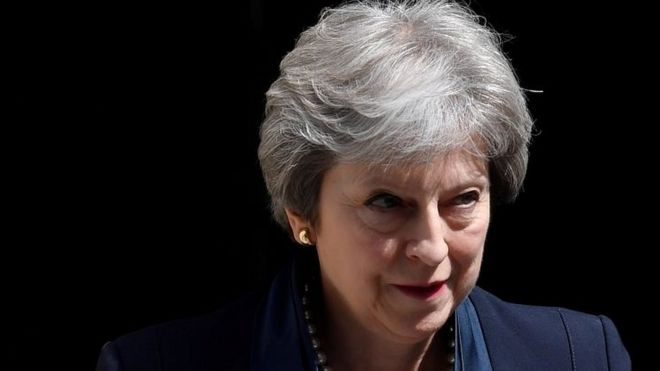
In one of the better villain lines of cinematic history, James Mason’s character in North By Northwest describes a troublesome adversary as “a matter best disposed of at a great height ... over water”. Would that this expedient solution was available to the Conservative Party which - having missed many opportunities during Theresa May’s Humiliation Tour of Europe over recent months - now faces the ghastly prospect of a Vote Of Confidence.
Events are moving fast; even given the normally ephemeral nature of blogging, Sordel sets finger to keyboard knowing that suspense will be brief and the matter largely settled either today or shortly thereafter. Yet, so rich & aromatic is this smoke for the connoisseur of game theory that it is irrestistable to draw it in and linger over it for a moment before breathing it back into the air to be lost forever.
In terms of tactics nothing should be more simple. The Prime Minister clearly does not carry the confidence of her party. No fewer than a hundred were expected to vote against her Brexit deal had she not put the motion back in her pocket and walked away whistling. If a hundred would oppose in public, it's a reasonable guess that others would oppose given the luxury of a secret ballot. On paper, Brexiters (whose letters largely, if not exclusively, triggered the vote) should vote against her. Remainers should vote against her.
Yet behind these seemingly straightforward decisions there is a lot for a Tory to ponder. Moderate Remainers and Brexiters could probably rally around the current deal to avoid the possibilities of No Deal or a so-called “People’s Vote” (which is just another referendum only this time made less threatening to anyone intimidated by four-syllable words). Hardline Brexiters have to weigh the possibility of wielding the knife yet losing the crown. And noisy Remainers face the exquisite paradox that although they are very keen to extend a vote to the country in general, they are genuinely terrified of putting a choice to their own party membership, who are very likely to impose a Brexiter leader should the vote fall to a free choice between a candidate from one of the party’s two extreme wings.
So although Conservative MPs don’t back Theresa May, there can be very little appetite to remove her. If she wins the vote, she is entitled to stay as leader: she cannot be challenged again for twelve months.
This is the key problem.
For while the parliamentary party might be happy to leave her in place severely wounded, there can be no delight anywhere at the prospect of giving her security of tenure until after Brexit. Unfortunately for her, the Prime Minister is not at all trusted by either wing: putting the Union in jeopardy has alienated even the somewhat Brexit-agnostic to her right; pulling the vote and humiliating the party has enflamed the paranoia of those to her Left to such an extent that it is widely suspected that she is engineering a stealth No Deal. Should either mistrust prove founded, there would be the numbers to support an opposition-led No Confidence vote, but that would be the only way to remove her and they would have to face a General Election whose result is highly uncertain.
The twelve-month moritorium on further votes was introduced to give the leader some security again endless Votes of Confidence, but it may prove to the decisive factor in unseating Mrs. May. A calculating Tory MP on the Remain side might rationally conclude that keeping her in place is hardly worse than having even the most loathed Brexiter in her place. (Indeed, there is a reasonable argument for saying that a loathed Brexiter in her place might be very good for a Remainer, giving considerable cover for moves against future government motions.)
When neither wing has a possible route to victory, it hardly matters what the result is, and that's how Mrs. May got the job in the first place.
[Image copyright: Reuters]
Showing posts with label British Politics. Show all posts
Wednesday, December 12, 2018
Friday, June 24, 2016
Careful What You Wish For
Like participants in an especially hedonistic stag party, UK voters awakened today to the challenge of distinguishing reality from the ghastly fever dream that had troubled their sleep. A dawning realisation will be transferred from face to face as people pass one another on the street and look nervously away. By God, it's true, we did that.
That (for those tripping over this very small corner of the internet whilst looking for something else in years to come) is this: the UK voted to leave the EU. Yes, the Little Train That Couldn't, did, and it turns out that Casey Jones was at the engine, going full steam to catastrophe.
When many of us went to bed last night we did so in a markedly different world: Farage had reputedly conceded; David Dimbleby had announced that the pro-EU campaign seemed to have prevailed; and even the pro-Leave talking heads seemed to think that the issue had been settled for the status quo. This consensus, however, was based on the idea that a large turnout would favour Remain: a narrative that was at odds with what many were saying about the demographic of their supporters. If those who vote Remain are the most educated, metropolitan, Guardian-reading members of society, aren't these the people who reliably vote in every election? Who were these other people registering and voting in large numbers? Why was the assumption that people who took too little interest in politics to vote in a General Election were suddenly rallying to the flag of the European Union?
The reality of the matter - that the Leave campaign had prevailed on the basis of a massive turnout - has proven to be a national act of civil disobedience. The vice anglais was well-named: the British people has cast aside its safe word and asking to be whipped a little harder please Miss. We're often told in the political context that turkeys don't vote for Christmas, yet the UK electorate has basted itself, cooked itself to perfection and has a saucière of cranberry sauce balanced on its left wing.
Quite why that is we will probably never know because the votes that swung this referendum are not the votes that we could see (the active, UKIP-voting people of Middle England who could be heard on every radio debate prior to voting day) but the votes that we couldn't: the quiet, unannounced votes that tipped the balance.
But if you're looking around today for someone to blame in the weeks, months, perhaps years to come, it's worth bearing in mind that the referendum only took place due to a cynical piece of manoeuvring from the man who professed to want it least. David Cameron jeopardised (History may say "sacrificed") his entire nation solely to minimise the UKIP vote at the last General Election, promising a referendum that would/could never pass in a bid to cling to power. On the morning after the night before, he proved to be not the result's only - but certainly its most prominent - casualty.
If the poets have tragedies yet to write then let them ponder that.
That (for those tripping over this very small corner of the internet whilst looking for something else in years to come) is this: the UK voted to leave the EU. Yes, the Little Train That Couldn't, did, and it turns out that Casey Jones was at the engine, going full steam to catastrophe.
When many of us went to bed last night we did so in a markedly different world: Farage had reputedly conceded; David Dimbleby had announced that the pro-EU campaign seemed to have prevailed; and even the pro-Leave talking heads seemed to think that the issue had been settled for the status quo. This consensus, however, was based on the idea that a large turnout would favour Remain: a narrative that was at odds with what many were saying about the demographic of their supporters. If those who vote Remain are the most educated, metropolitan, Guardian-reading members of society, aren't these the people who reliably vote in every election? Who were these other people registering and voting in large numbers? Why was the assumption that people who took too little interest in politics to vote in a General Election were suddenly rallying to the flag of the European Union?
The reality of the matter - that the Leave campaign had prevailed on the basis of a massive turnout - has proven to be a national act of civil disobedience. The vice anglais was well-named: the British people has cast aside its safe word and asking to be whipped a little harder please Miss. We're often told in the political context that turkeys don't vote for Christmas, yet the UK electorate has basted itself, cooked itself to perfection and has a saucière of cranberry sauce balanced on its left wing.
Quite why that is we will probably never know because the votes that swung this referendum are not the votes that we could see (the active, UKIP-voting people of Middle England who could be heard on every radio debate prior to voting day) but the votes that we couldn't: the quiet, unannounced votes that tipped the balance.
But if you're looking around today for someone to blame in the weeks, months, perhaps years to come, it's worth bearing in mind that the referendum only took place due to a cynical piece of manoeuvring from the man who professed to want it least. David Cameron jeopardised (History may say "sacrificed") his entire nation solely to minimise the UKIP vote at the last General Election, promising a referendum that would/could never pass in a bid to cling to power. On the morning after the night before, he proved to be not the result's only - but certainly its most prominent - casualty.
If the poets have tragedies yet to write then let them ponder that.
Labels:
Bremain,
Brexit,
British Politics,
Conservative Party,
David Cameron,
David Dimbleby,
EU,
Nigel Farage,
Referendum,
UKIP
Thursday, June 21, 2012
Your Cheating Heart
The Times leader today has a lesson for those of us interested in the ethical status of tax avoidance: "Tax avoidance is not justified solely by the plea that it is within the law. Tax avoidance is a way of playing the system to gain reward that has not genuinely been earned. It is, indeed, a form of cheating."
Not so, O mighty Some-guy-behind-an-editor's-desk. If a game has rules and you play within the rules, then you are not cheating. There is no "spirit of the rules" to a game: Fool's Check is not a friendly thing to do to someone, but it is an exploitation of a position on which the rules of Chess pass no comment. In Chess, if you're stupid enough to walk into Fool's Check, tough luck.
While tax avoidance does, therefore, seem to have some sort of ethical character, it is precisely not cheating. (Which is just as well, because I'm not sure that cheating is immoral either, in and of itself.)
You might counter: this is not a game, it is people's lives & livelihoods. And you'd be right. But for someone to be cheating on the tax non-game, you'd need to show that there are two parties to the relationship, and most of us do not sign up to be taxed.
In the extreme, it's like saying that you would be cheating not to mention the fiver you have in your back pocket in the course of being mugged. Tax money is not a voluntary payment and most of us have it subtracted by our employer before we ever get our hands on a wage.
Before you tell me that there's an implicit Social Contract ... who told you that? Was it the guy who has your wallet, by any chance, and is haring down the nearest ally to blow your money on foreign wars and bail-outs for bankers? Did he mention that he was only going spend your money on the National Health Service and the Police Services before or after he relieved you of your watch & wedding ring?
Moreover, HMRC does not play within the rules of a game: it makes the rules. But the most ghastly rules ever made with regard to taxation is this: you are now regarded as morally culpable if you do something deemed intended to avoid tax.
Imagine that you are driving your car at 49 mph in a 50 mph speed limit, when you are pulled over by the police. It seems that driving at 49 mph is now deemed as penalty avoidance and the police rely on those penalties to support policing in the area. You have a car more than capable of 130 mph, you wealthy bastard. Stop grinding the faces of people who can only afford a bicycle.
Then when you get home there's a letter from HMRC condemning you for attempting to avoid VAT by saving your money rather than spending it: they have ordered a new television for you and charged your credit card accordingly. Oh, and they find that you could afford the mortgage on a house in a higher Council Tax band, so the furniture van will be calling next Thursday, some time between midnight and midnight.
Oh, and if it's against the law to enter into a scheme to avoid paying tax, there will be a lot of people after the next election looking very shame-faced ... because avoiding tax has always been the strongest reason for voting Conservative.
Not so, O mighty Some-guy-behind-an-editor's-desk. If a game has rules and you play within the rules, then you are not cheating. There is no "spirit of the rules" to a game: Fool's Check is not a friendly thing to do to someone, but it is an exploitation of a position on which the rules of Chess pass no comment. In Chess, if you're stupid enough to walk into Fool's Check, tough luck.
While tax avoidance does, therefore, seem to have some sort of ethical character, it is precisely not cheating. (Which is just as well, because I'm not sure that cheating is immoral either, in and of itself.)
You might counter: this is not a game, it is people's lives & livelihoods. And you'd be right. But for someone to be cheating on the tax non-game, you'd need to show that there are two parties to the relationship, and most of us do not sign up to be taxed.
In the extreme, it's like saying that you would be cheating not to mention the fiver you have in your back pocket in the course of being mugged. Tax money is not a voluntary payment and most of us have it subtracted by our employer before we ever get our hands on a wage.
Before you tell me that there's an implicit Social Contract ... who told you that? Was it the guy who has your wallet, by any chance, and is haring down the nearest ally to blow your money on foreign wars and bail-outs for bankers? Did he mention that he was only going spend your money on the National Health Service and the Police Services before or after he relieved you of your watch & wedding ring?
Moreover, HMRC does not play within the rules of a game: it makes the rules. But the most ghastly rules ever made with regard to taxation is this: you are now regarded as morally culpable if you do something deemed intended to avoid tax.
Imagine that you are driving your car at 49 mph in a 50 mph speed limit, when you are pulled over by the police. It seems that driving at 49 mph is now deemed as penalty avoidance and the police rely on those penalties to support policing in the area. You have a car more than capable of 130 mph, you wealthy bastard. Stop grinding the faces of people who can only afford a bicycle.
Then when you get home there's a letter from HMRC condemning you for attempting to avoid VAT by saving your money rather than spending it: they have ordered a new television for you and charged your credit card accordingly. Oh, and they find that you could afford the mortgage on a house in a higher Council Tax band, so the furniture van will be calling next Thursday, some time between midnight and midnight.
Oh, and if it's against the law to enter into a scheme to avoid paying tax, there will be a lot of people after the next election looking very shame-faced ... because avoiding tax has always been the strongest reason for voting Conservative.
Labels:
British Politics,
Conservative Party,
David Cameron,
Ethics,
Taxation
Friday, May 4, 2012
Cameron Behind
A report in The Huffington Post this morning suggests that Tory activists have been using tactical voting methods in the London mayoral elections in an effort to push Liberal Democrats candidate Brian Paddick into a humiliating fourth or fifth place.
Even The Huffington Post's own article suggests that the number of voters using this tactic may be very low, but it is sadly indicative of the times that it should even have been formulated.
Ever since the Tories romped back to power, they have behaving like someone who has stepped in something, desperately scraping the soles of their shoes in order to remove the Lib Dems. Indeed, for the first year of the coalition government both Labour and the Conservatives found common ground in their desire to return the Lib Dems to their former state of total unelectability.
That was all very well when the Conservatives were working towards the idea of a clean victory in 2015, but right now hopes of that seem to be draining away.
Moreover, events may yet conspire to strengthen the Lib Dems' hand. Remember Business Secretary Vince Cable, whose responsibilities to oversee News Corp's bid for BSkyB were removed from him and given to Jeremy Hunt? At the time Cable was made to look very stupid by a Daily Telegraph sting (which was later the subject of a successful complaint to the Press Complaints Commission). Now, however, he looks remarkably like the only British politician to shake hands with the Murdochs and retain his small change & pocket watch.
To a different extent the same can be said of Clegg himself. Having been variously depicted as hapless, clueless and ineffectual, he can scarcely be portrayed now as having anything more than a bystander role in the policies that have proved most unpopular for the coalition. While George Osborne was preparing his politically catastrophic budget, Clegg & Cable were pushing the idea of a "Mansion Tax".
As fig leaves go it may be small, but it beats going around stark bollock naked.
Of course, the recovery in Lib Dem fortunes has been predicted more often than the end of the world, the only difference between them being that at some point the world assuredly will end. Of less concern to the Conservatives than the rise of the Lib Dems, however, will be their own fall: something in which they are likely to prove the principal architect. Had they kept the Lib Dems relatively strong, they might have prevented Labour from jumping from third place into first in the Birmingham council elections last night.
In an ideal world the Lib Dems could act like a hedge fund for the Tories: an opportunity to invest both in ice creams and umbrellas. Right now - as Britain wrings out its prematurely knotted handkerchiefs beneath the pitilessly grey Spring skies - Cameron seems to have gone full-tilt into the ice cream business.
Even The Huffington Post's own article suggests that the number of voters using this tactic may be very low, but it is sadly indicative of the times that it should even have been formulated.
Ever since the Tories romped back to power, they have behaving like someone who has stepped in something, desperately scraping the soles of their shoes in order to remove the Lib Dems. Indeed, for the first year of the coalition government both Labour and the Conservatives found common ground in their desire to return the Lib Dems to their former state of total unelectability.
That was all very well when the Conservatives were working towards the idea of a clean victory in 2015, but right now hopes of that seem to be draining away.
Moreover, events may yet conspire to strengthen the Lib Dems' hand. Remember Business Secretary Vince Cable, whose responsibilities to oversee News Corp's bid for BSkyB were removed from him and given to Jeremy Hunt? At the time Cable was made to look very stupid by a Daily Telegraph sting (which was later the subject of a successful complaint to the Press Complaints Commission). Now, however, he looks remarkably like the only British politician to shake hands with the Murdochs and retain his small change & pocket watch.
To a different extent the same can be said of Clegg himself. Having been variously depicted as hapless, clueless and ineffectual, he can scarcely be portrayed now as having anything more than a bystander role in the policies that have proved most unpopular for the coalition. While George Osborne was preparing his politically catastrophic budget, Clegg & Cable were pushing the idea of a "Mansion Tax".
As fig leaves go it may be small, but it beats going around stark bollock naked.
Of course, the recovery in Lib Dem fortunes has been predicted more often than the end of the world, the only difference between them being that at some point the world assuredly will end. Of less concern to the Conservatives than the rise of the Lib Dems, however, will be their own fall: something in which they are likely to prove the principal architect. Had they kept the Lib Dems relatively strong, they might have prevented Labour from jumping from third place into first in the Birmingham council elections last night.
In an ideal world the Lib Dems could act like a hedge fund for the Tories: an opportunity to invest both in ice creams and umbrellas. Right now - as Britain wrings out its prematurely knotted handkerchiefs beneath the pitilessly grey Spring skies - Cameron seems to have gone full-tilt into the ice cream business.
Subscribe to:
Posts (Atom)
