Showing posts with label Brexit. Show all posts

Monday, December 16, 2019

Designated Driver

There’s a stereotype about male drivers that they would rather drive twenty miles in the wrong direction than stop and check a map. Broadly speaking, this is what happened in the UK General Election. Despite the fact that there is considerable evidence that a majority of the electorate believes that the Brexit referendum came to the wrong decision (neither a “stonking” majority, nor a “thumping” one, but a majority nonetheless) UK voters made the net decision to drive on down the road in the hope that they would either locate a convenient and well-signposted junction on which to change direction or, better, would discover that they were on the right road all along.

What this means is that the issue of Brexit has been settled for a generation. (That's about eighteen months if you live North of the border.) What will they all argue about now?

It seems that the Labour Party is going to be riven (at least for the three months that it will take them to coalesce jubilantly around a new leader) by the question of what is to blame for its ignominious defeat. The analysis from the Left (for how could it be otherwise) is that the party was effectively run down in the street: it had been minding its own business, embracing ideals that were being warmly endorsed by the population in general, when it was brutally mown down by the issue of Brexit.

Labour Centrists, on the other hand, argue that holding a Marxist rally in middle of the South Circular was asking for trouble in the first place. A muddled message on Brexit was as nothing to the suspicion with which Corbyn himself was viewed by “traditional Labour voters”.

There’s room for both sides to be correct.

The sunny days of Corbyn’s Indian Summer, when he gambolled at festivals in the company of gaggles of doe-eyed supporters, seemed already long past when this election was called. He had done little enough to earn their adulation in the first place and little enough to estrange it in the last two years. It was just gone.

Certainly there was still enthusiasm for Corbyn, but it was the grim resolve of Jonestown rather than the febrile tunnel vision of a popular mass movement. The “Youthquake” had moved on to Extinction Rebellion with a more direct means of expression than the quiet anonymity of the ballot box.

Boris’s advantage was not that he was easy to like but that he was difficult to hate. Many managed to do so but nowhere near enough. It’s difficult to associate the image of a racist, sexist hard-Right politician with the photo ops that he gave in a fishmarket or delivering milk. Boris’s lies were legion, but they appeared, somehow, to be little white lies.

Corbyn’s truths were also legion, but they were great big scary truths full of class envy & social division. There was much in them with which voters widely sympathise, but ideals such as Corbyn’s are perhaps best viewed through the prism of a more pragmatic leader.

Finally, a word about Jo Swinson, the “blink and you missed her” leader of the Liberal Democrats. She has never appeared before in these pages as a label, nor is she likely to do so in the future, but there was something bitterly unfair about her constituency defeat. Her candid & straightforward approach to politics was a refreshing alternative to the cynicism of the Right and the fanaticism of the Left. This is one nutshell, however, where the middle of the road is a bad place to be.

Thursday, September 26, 2019

Boris Treads The Boards

The Commons (currently of no practical use as a place where the country's laws are written) has reverted to its alternative use as a theatre. When a theatre goes dark it does so in the expectation that a bold new production is in preparation. That is what our freshman Prime Minister managed to deliver yesterday.

As it turns out, we could have all saved ourselves the trouble of learning the word prorogation because The Supreme Court decided that Boris’s attempt to prorogue parliament was void. Consequently Boris was now up before the Beak: dragged back to the Commons to be served with as many of the best as UK MPs could deliver before their arms got tired. And none of them looked like their arms were going to get tired any time soon.

This was make or break for Johnson. His one & only Question Time - during which his bumbling delivery sounded rather clueless in the chamber - had not gone well. That, mind you, was before the highest court in the land had ruled that he had broken the law. Media coverage the day before had depicted this as a humiliating defeat and, worse, the Queen (talismanic to the majority of Conservative voters) had been caught in the crossfire, threatening to divide the government's core supporters. But early notice was given that the show might run as expected when Attorney General Geoffrey Cox gave a surprisingly feisty performance at the matinée. Like or loathe his manner (which is not so much that of a great barrister as that of a ham actor playing a great barrister) Cox steadied the ship, giving the Tories something to cheer about with more heartfelt sincerity than most of them can have thought possible.

The set piece debate that Johnson opened with a statement on the legal ruling was meant to go like this. Opposition MP after MP was lined up to say, again & again, that he had been found to have “mislead the people” by a “unanimous” decision of the court, was “unfit for office” and would, “if he had any shame” resign. This basic template was only varied by the SNP, who mixed in other sentiments in keeping with their nation's long cherished desire for liberty.

None of this needed to be said for the purposes of proceedings in parliament: it was all designed to send a message as many times as possible to television viewers. As such, like so many Commons deliberations, it was all hot air, if rather hotter than usual.

Johnson came back with a debater's trick: the Supreme Court judgement was a sideshow & in his opinion wrong ... the real issue was Brexit. And, surprisingly, it worked. Many opposition MPs, attracted both by the shiny word Brexit and the Prime Minister's gall in criticising the judgement, started responding to his narrative instead of following the agreed script. They were supposed to be furious about one thing ... now they were being furious about something else, or perhaps everything.

Then Johnson unleashed the phrase “Surrender bill” which has been kicking around for a while: it's like a nickname that the unpopular boy at school keeps using in the hope that everyone else will think it's as clever as he does. And, amazingly, the fish bit down hard on this unpromising bait. MP after MP stood up to say that it was quite improper, and probably dangerous, to describe a piece of legislation that had been written into law as a “surrender bill”. At which Boris would neatly reply that it certainly was a surrender bill, or capitulation bill if you prefer. Terms that had never had much currency before were suddenly being used on both sides of the House. And the angrier the Opposition got, the more strident they got while Johnson (after a couple of veiled but unambiguous appeals from the Speaker) dropped into a conciliatory tone, looking reasonable and - it has to be said - rather pleased with himself.

Boris had lost the judgement and won the debate.

Sordel says “won the debate” not “won the argument”. Many people, perhaps most people, will feel that Boris's bad guy act (especially on the subject of Jo Cox) was in poor taste and his thespian artistry was nothing more than Public School playacting, far removed from national concerns of pressing importance. But if this parliament has nothing to legislate - if it is essentially a bear pit in which the most vicious rhetorician prevails - then Boris managed to turn the tables on his opponents. They will consider their strategy more carefully before giving him hours at the despatch box next time.

The opposition emerged bloodied from the encounter: none more so than Jeremy Corbyn, who looked ashen when Nigel Dodds reminded a silent house that the Labour leader's new-found respect for the Rule of Law came too late for judges murdered by the IRA. Politicians who had sued for the right to recall parliament must have ended the day bitterly regretting their victory. As so many disinterested onlookers must do.

If this Boris show is not swiftly shuttered it may run & run.


(Illustration copyright Simon Haynes. Ironically it is reproduced from an article from July 2018 on whether that month would finally see the end of Boris Johnson.)

Wednesday, December 12, 2018

How Do You Solve A Problem Like Theresa?

In one of the better villain lines of cinematic history, James Mason’s character in North By Northwest describes a troublesome adversary as “a matter best disposed of at a great height ... over water”. Would that this expedient solution was available to the Conservative Party which - having missed many opportunities during Theresa May’s Humiliation Tour of Europe over recent months - now faces the ghastly prospect of a Vote Of Confidence.

Events are moving fast; even given the normally ephemeral nature of blogging, Sordel sets finger to keyboard knowing that suspense will be brief and the matter largely settled either today or shortly thereafter. Yet, so rich & aromatic is this smoke for the connoisseur of game theory that it is irrestistable to draw it in and linger over it for a moment before breathing it back into the air to be lost forever.

In terms of tactics nothing should be more simple. The Prime Minister clearly does not carry the confidence of her party. No fewer than a hundred were expected to vote against her Brexit deal had she not put the motion back in her pocket and walked away whistling. If a hundred would oppose in public, it's a reasonable guess that others would oppose given the luxury of a secret ballot. On paper, Brexiters (whose letters largely, if not exclusively, triggered the vote) should vote against her. Remainers should vote against her.

Yet behind these seemingly straightforward decisions there is a lot for a Tory to ponder. Moderate Remainers and Brexiters could probably rally around the current deal to avoid the possibilities of No Deal or a so-called “People’s Vote” (which is just another referendum only this time made less threatening to anyone intimidated by four-syllable words). Hardline Brexiters have to weigh the possibility of wielding the knife yet losing the crown. And noisy Remainers face the exquisite paradox that although they are very keen to extend a vote to the country in general, they are genuinely terrified of putting a choice to their own party membership, who are very likely to impose a Brexiter leader should the vote fall to a free choice between a candidate from one of the party’s two extreme wings.

So although Conservative MPs don’t back Theresa May, there can be very little appetite to remove her. If she wins the vote, she is entitled to stay as leader: she cannot be challenged again for twelve months.

This is the key problem.

For while the parliamentary party might be happy to leave her in place severely wounded, there can be no delight anywhere at the prospect of giving her security of tenure until after Brexit. Unfortunately for her, the Prime Minister is not at all trusted by either wing: putting the Union in jeopardy has alienated even the somewhat Brexit-agnostic to her right; pulling the vote and humiliating the party has enflamed the paranoia of those to her Left to such an extent that it is widely suspected that she is engineering a stealth No Deal. Should either mistrust prove founded, there would be the numbers to support an opposition-led No Confidence vote, but that would be the only way to remove her and they would have to face a General Election whose result is highly uncertain.

The twelve-month moritorium on further votes was introduced to give the leader some security again endless Votes of Confidence, but it may prove to the decisive factor in unseating Mrs. May. A calculating Tory MP on the Remain side might rationally conclude that keeping her in place is hardly worse than having even the most loathed Brexiter in her place. (Indeed, there is a reasonable argument for saying that a loathed Brexiter in her place might be very good for a Remainer, giving considerable cover for moves against future government motions.)

When neither wing has a possible route to victory, it hardly matters what the result is, and that's how Mrs. May got the job in the first place.

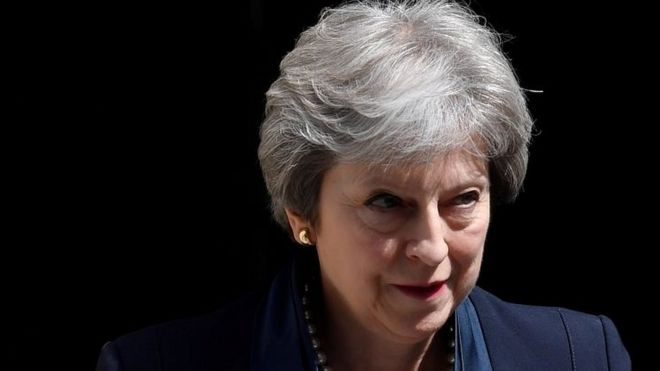
[Image copyright: Reuters]


Friday, June 24, 2016

Careful What You Wish For

Like participants in an especially hedonistic stag party, UK voters awakened today to the challenge of distinguishing reality from the ghastly fever dream that had troubled their sleep. A dawning realisation will be transferred from face to face as people pass one another on the street and look nervously away. By God, it's true, we did that.

That (for those tripping over this very small corner of the internet whilst looking for something else in years to come) is this: the UK voted to leave the EU. Yes, the Little Train That Couldn't, did, and it turns out that Casey Jones was at the engine, going full steam to catastrophe.

When many of us went to bed last night we did so in a markedly different world: Farage had reputedly conceded; David Dimbleby had announced that the pro-EU campaign seemed to have prevailed; and even the pro-Leave talking heads seemed to think that the issue had been settled for the status quo. This consensus, however, was based on the idea that a large turnout would favour Remain: a narrative that was at odds with what many were saying about the demographic of their supporters. If those who vote Remain are the most educated, metropolitan, Guardian-reading members of society, aren't these the people who reliably vote in every election? Who were these other people registering and voting in large numbers? Why was the assumption that people who took too little interest in politics to vote in a General Election were suddenly rallying to the flag of the European Union?

The reality of the matter - that the Leave campaign had prevailed on the basis of a massive turnout - has proven to be a national act of civil disobedience. The vice anglais was well-named: the British people has cast aside its safe word and asking to be whipped a little harder please Miss. We're often told in the political context that turkeys don't vote for Christmas, yet the UK electorate has basted itself, cooked itself to perfection and has a saucière of cranberry sauce balanced on its left wing.

Quite why that is we will probably never know because the votes that swung this referendum are not the votes that we could see (the active, UKIP-voting people of Middle England who could be heard on every radio debate prior to voting day) but the votes that we couldn't: the quiet, unannounced votes that tipped the balance.

But if you're looking around today for someone to blame in the weeks, months, perhaps years to come, it's worth bearing in mind that the referendum only took place due to a cynical piece of manoeuvring from the man who professed to want it least. David Cameron jeopardised (History may say "sacrificed") his entire nation solely to minimise the UKIP vote at the last General Election, promising a referendum that would/could never pass in a bid to cling to power. On the morning after the night before, he proved to be not the result's only - but certainly its most prominent - casualty.

If the poets have tragedies yet to write then let them ponder that.

Tuesday, June 21, 2016

The Little Train That Couldn't

If you believe the mythology of these things, Neil Kinnock sunk Labour's chances of victory in the 1992 General Election at a rally in Sheffield where he uttered the deathless soundbite "We're alright!" The rally - which fittingly took place on April Fool's Day - is notable as being just about the last time in British political history that a politician ever made the mistake of showing spontaneous feeling at a conference podium. But the sentiment was at least positive.

Two days out from the EU Referendum, Sordel is ready to capitulate to the prevailing logic. Cameron has me convinced. The Department of Trade & Industry can't negotiate trade agreements. Countries investing in Britain are not after anything that we have to trade; they are primarily interested in our access to the Continental marketplace. Membership of NATO and the United Nations counts for nothing, and if you're pining for The Commonwealth, pine on Grandad. Britain cannot make it on its own, and certainly not with any of the likely potential pilots at the helm.

And this isn't sarcasm.

There is, admittedly, a positive argument for remaining in the EU. We're better inside helping shape the decisions than outside suffering the consequences of them. This affords the UK to effect genuine global change through multilateral action with European partners irrespective of their frankly waning power and relevance. None of that is wrong; people join exclusive clubs for a reason and they don't give up membership on a whim or without qualms.

But the positive logic is as nothing compared with the negative logic of staying in Europe. The UK didn't need an EU to shape international affairs in the past, but then it had leaders who would not have dreamed of devoting months of their time fighting a completely unnecessary referendum on the basis of the UK's fundamental weakness.

This is not party political sniping: Labour, Conservatives and Lib Dems (whatever happened to them?) are as one on this point. It can't be done, and - if it could - we can't do it.

Maybe some other UK with some other leader. Not this one. Not with Cameron, or Corbyn, or (let me check my notes) Tim Farron. Not with Boris Johnson, Nigel Farage or Michael Gove either, lest you think that Sordel dreams of princes across the sea.

If you can't trust your politicians, Brexit is too big a risk to take, which is why I cannot vote for it.

Cometh the Hour, Cometh the Slogan, and the slogan for these times is this: "We're All Wrong."