In August 2017 the time-travelling author of these pages anticipated that one day Gone With The Wind would be withdrawn from circulation due to its complicity with America's racist history. That moment grew closer yesterday when the movie was withdrawn from streaming services as a painless casualty of the Black Lives Matter movement. The lionhearts who removed it “said the 1939 film was "a product of its time" and depicted "ethnic and racial prejudices" that "were wrong then and are wrong today", which does raise the question of why it was licensed and broadcast by the service in the first place. In the eighty years since it was made, how was its manifestly inappropriate nature overlooked by anyone able to turn a profit on it?
Sordel doesn't care about Gone With The Wind and (in a they-first-came-for-the-Communists stylee) is unlikely to lose much sleep over its reversal of fortune, but consider the plight of the first African-American to win an Academy Award in an acting category. Hattie McDaniel, who won the Oscar for Best Supporting Actress at a segregated ceremony in 1940, should surely have known that the depiction of her character was “wrong then”, and in taking the role she was arguably as complicit with the racism of 1939 as Mammy was with the culture of the antebellum South. If, as I sincerely hope, her achievement continues to command some respect going forward, what will it mean that the film in which she appeared is reviled by later generations, joining Birth of a Nation and Song Of The South (together with every film associated with Harvey Weinstein, Kevin Spacey and Woody Allen) in cinema's Book of the Damned?
In one sense, it should be crystal clear that black lives matter or, to put it more pertinently, that black deaths matter. All deaths at the hands of the police matter, which is why Sordel remembers the case of Ian Tomlinson, the newspaper vendor who was meted out an unintentional on-the-spot death penalty for mouthing off to a riot policeman.
In another sense, however, the BLM movement unpicks history statue by statue, removing the context in which future generations might learn about it. Black lives, in the sense of their biographies, matter, but theirs is past that we have reason to discover only because of the visible history from which they were so often excluded. I strongly doubt that anyone in Bristol actually revered Edward Colston because he had his name on stuff. But while his name was on stuff it gave parents the opportunity to point out to their children that Edward Colston made his money in the slave industry. Alfred Nobel (at the time of the premature publication of his obituary) was described as “The Merchant of Death”. Cecil Rhodes remains an antagonistic figure, prompting people to research the history of colonial rule in South Africa, precisely because he remains relevant to us as a philanthropist. If you really want people to understand how the morally-compromised wealth of the past gives rise to the inequality of the present, you need the past to remain present rather than sanitising it.
When all this is gone with the wind, many careers that might have been celebrated by the new social order will have gone with it. If you think that an acting achievement will be written in stone, consider that the first African-American actor to win an Academy Award was James Baskett, who won an honorary Oscar for playing Uncle Remus in Song of the South. If you don’t know who that is, Sordel can hardly blame you.
Thursday, June 11, 2020
Monday, December 16, 2019
Designated Driver
There’s a stereotype about male drivers that they would rather drive twenty miles in the wrong direction than stop and check a map. Broadly speaking, this is what happened in the UK General Election. Despite the fact that there is considerable evidence that a majority of the electorate believes that the Brexit referendum came to the wrong decision (neither a “stonking” majority, nor a “thumping” one, but a majority nonetheless) UK voters made the net decision to drive on down the road in the hope that they would either locate a convenient and well-signposted junction on which to change direction or, better, would discover that they were on the right road all along.
What this means is that the issue of Brexit has been settled for a generation. (That's about eighteen months if you live North of the border.) What will they all argue about now?
It seems that the Labour Party is going to be riven (at least for the three months that it will take them to coalesce jubilantly around a new leader) by the question of what is to blame for its ignominious defeat. The analysis from the Left (for how could it be otherwise) is that the party was effectively run down in the street: it had been minding its own business, embracing ideals that were being warmly endorsed by the population in general, when it was brutally mown down by the issue of Brexit.
Labour Centrists, on the other hand, argue that holding a Marxist rally in middle of the South Circular was asking for trouble in the first place. A muddled message on Brexit was as nothing to the suspicion with which Corbyn himself was viewed by “traditional Labour voters”.
There’s room for both sides to be correct.
The sunny days of Corbyn’s Indian Summer, when he gambolled at festivals in the company of gaggles of doe-eyed supporters, seemed already long past when this election was called. He had done little enough to earn their adulation in the first place and little enough to estrange it in the last two years. It was just gone.
Certainly there was still enthusiasm for Corbyn, but it was the grim resolve of Jonestown rather than the febrile tunnel vision of a popular mass movement. The “Youthquake” had moved on to Extinction Rebellion with a more direct means of expression than the quiet anonymity of the ballot box.
Boris’s advantage was not that he was easy to like but that he was difficult to hate. Many managed to do so but nowhere near enough. It’s difficult to associate the image of a racist, sexist hard-Right politician with the photo ops that he gave in a fishmarket or delivering milk. Boris’s lies were legion, but they appeared, somehow, to be little white lies.
Corbyn’s truths were also legion, but they were great big scary truths full of class envy & social division. There was much in them with which voters widely sympathise, but ideals such as Corbyn’s are perhaps best viewed through the prism of a more pragmatic leader.
Finally, a word about Jo Swinson, the “blink and you missed her” leader of the Liberal Democrats. She has never appeared before in these pages as a label, nor is she likely to do so in the future, but there was something bitterly unfair about her constituency defeat. Her candid & straightforward approach to politics was a refreshing alternative to the cynicism of the Right and the fanaticism of the Left. This is one nutshell, however, where the middle of the road is a bad place to be.
What this means is that the issue of Brexit has been settled for a generation. (That's about eighteen months if you live North of the border.) What will they all argue about now?
It seems that the Labour Party is going to be riven (at least for the three months that it will take them to coalesce jubilantly around a new leader) by the question of what is to blame for its ignominious defeat. The analysis from the Left (for how could it be otherwise) is that the party was effectively run down in the street: it had been minding its own business, embracing ideals that were being warmly endorsed by the population in general, when it was brutally mown down by the issue of Brexit.
Labour Centrists, on the other hand, argue that holding a Marxist rally in middle of the South Circular was asking for trouble in the first place. A muddled message on Brexit was as nothing to the suspicion with which Corbyn himself was viewed by “traditional Labour voters”.
There’s room for both sides to be correct.
The sunny days of Corbyn’s Indian Summer, when he gambolled at festivals in the company of gaggles of doe-eyed supporters, seemed already long past when this election was called. He had done little enough to earn their adulation in the first place and little enough to estrange it in the last two years. It was just gone.
Certainly there was still enthusiasm for Corbyn, but it was the grim resolve of Jonestown rather than the febrile tunnel vision of a popular mass movement. The “Youthquake” had moved on to Extinction Rebellion with a more direct means of expression than the quiet anonymity of the ballot box.
Boris’s advantage was not that he was easy to like but that he was difficult to hate. Many managed to do so but nowhere near enough. It’s difficult to associate the image of a racist, sexist hard-Right politician with the photo ops that he gave in a fishmarket or delivering milk. Boris’s lies were legion, but they appeared, somehow, to be little white lies.
Corbyn’s truths were also legion, but they were great big scary truths full of class envy & social division. There was much in them with which voters widely sympathise, but ideals such as Corbyn’s are perhaps best viewed through the prism of a more pragmatic leader.
Finally, a word about Jo Swinson, the “blink and you missed her” leader of the Liberal Democrats. She has never appeared before in these pages as a label, nor is she likely to do so in the future, but there was something bitterly unfair about her constituency defeat. Her candid & straightforward approach to politics was a refreshing alternative to the cynicism of the Right and the fanaticism of the Left. This is one nutshell, however, where the middle of the road is a bad place to be.
Thursday, September 26, 2019
Boris Treads The Boards
The Commons (currently of no practical use as a place where the country's laws are written) has reverted to its alternative use as a theatre. When a theatre goes dark it does so in the expectation that a bold new production is in preparation. That is what our freshman Prime Minister managed to deliver yesterday.
As it turns out, we could have all saved ourselves the trouble of learning the word prorogation because The Supreme Court decided that Boris’s attempt to prorogue parliament was void. Consequently Boris was now up before the Beak: dragged back to the Commons to be served with as many of the best as UK MPs could deliver before their arms got tired. And none of them looked like their arms were going to get tired any time soon.
This was make or break for Johnson. His one & only Question Time - during which his bumbling delivery sounded rather clueless in the chamber - had not gone well. That, mind you, was before the highest court in the land had ruled that he had broken the law. Media coverage the day before had depicted this as a humiliating defeat and, worse, the Queen (talismanic to the majority of Conservative voters) had been caught in the crossfire, threatening to divide the government's core supporters. But early notice was given that the show might run as expected when Attorney General Geoffrey Cox gave a surprisingly feisty performance at the matinée. Like or loathe his manner (which is not so much that of a great barrister as that of a ham actor playing a great barrister) Cox steadied the ship, giving the Tories something to cheer about with more heartfelt sincerity than most of them can have thought possible.
The set piece debate that Johnson opened with a statement on the legal ruling was meant to go like this. Opposition MP after MP was lined up to say, again & again, that he had been found to have “mislead the people” by a “unanimous” decision of the court, was “unfit for office” and would, “if he had any shame” resign. This basic template was only varied by the SNP, who mixed in other sentiments in keeping with their nation's long cherished desire for liberty.
None of this needed to be said for the purposes of proceedings in parliament: it was all designed to send a message as many times as possible to television viewers. As such, like so many Commons deliberations, it was all hot air, if rather hotter than usual.
Johnson came back with a debater's trick: the Supreme Court judgement was a sideshow & in his opinion wrong ... the real issue was Brexit. And, surprisingly, it worked. Many opposition MPs, attracted both by the shiny word Brexit and the Prime Minister's gall in criticising the judgement, started responding to his narrative instead of following the agreed script. They were supposed to be furious about one thing ... now they were being furious about something else, or perhaps everything.
Then Johnson unleashed the phrase “Surrender bill” which has been kicking around for a while: it's like a nickname that the unpopular boy at school keeps using in the hope that everyone else will think it's as clever as he does. And, amazingly, the fish bit down hard on this unpromising bait. MP after MP stood up to say that it was quite improper, and probably dangerous, to describe a piece of legislation that had been written into law as a “surrender bill”. At which Boris would neatly reply that it certainly was a surrender bill, or capitulation bill if you prefer. Terms that had never had much currency before were suddenly being used on both sides of the House. And the angrier the Opposition got, the more strident they got while Johnson (after a couple of veiled but unambiguous appeals from the Speaker) dropped into a conciliatory tone, looking reasonable and - it has to be said - rather pleased with himself.
Boris had lost the judgement and won the debate.
Sordel says “won the debate” not “won the argument”. Many people, perhaps most people, will feel that Boris's bad guy act (especially on the subject of Jo Cox) was in poor taste and his thespian artistry was nothing more than Public School playacting, far removed from national concerns of pressing importance. But if this parliament has nothing to legislate - if it is essentially a bear pit in which the most vicious rhetorician prevails - then Boris managed to turn the tables on his opponents. They will consider their strategy more carefully before giving him hours at the despatch box next time.
The opposition emerged bloodied from the encounter: none more so than Jeremy Corbyn, who looked ashen when Nigel Dodds reminded a silent house that the Labour leader's new-found respect for the Rule of Law came too late for judges murdered by the IRA. Politicians who had sued for the right to recall parliament must have ended the day bitterly regretting their victory. As so many disinterested onlookers must do.
If this Boris show is not swiftly shuttered it may run & run.
(Illustration copyright Simon Haynes. Ironically it is reproduced from an article from July 2018 on whether that month would finally see the end of Boris Johnson.)
As it turns out, we could have all saved ourselves the trouble of learning the word prorogation because The Supreme Court decided that Boris’s attempt to prorogue parliament was void. Consequently Boris was now up before the Beak: dragged back to the Commons to be served with as many of the best as UK MPs could deliver before their arms got tired. And none of them looked like their arms were going to get tired any time soon.
This was make or break for Johnson. His one & only Question Time - during which his bumbling delivery sounded rather clueless in the chamber - had not gone well. That, mind you, was before the highest court in the land had ruled that he had broken the law. Media coverage the day before had depicted this as a humiliating defeat and, worse, the Queen (talismanic to the majority of Conservative voters) had been caught in the crossfire, threatening to divide the government's core supporters. But early notice was given that the show might run as expected when Attorney General Geoffrey Cox gave a surprisingly feisty performance at the matinée. Like or loathe his manner (which is not so much that of a great barrister as that of a ham actor playing a great barrister) Cox steadied the ship, giving the Tories something to cheer about with more heartfelt sincerity than most of them can have thought possible.
The set piece debate that Johnson opened with a statement on the legal ruling was meant to go like this. Opposition MP after MP was lined up to say, again & again, that he had been found to have “mislead the people” by a “unanimous” decision of the court, was “unfit for office” and would, “if he had any shame” resign. This basic template was only varied by the SNP, who mixed in other sentiments in keeping with their nation's long cherished desire for liberty.
None of this needed to be said for the purposes of proceedings in parliament: it was all designed to send a message as many times as possible to television viewers. As such, like so many Commons deliberations, it was all hot air, if rather hotter than usual.
Johnson came back with a debater's trick: the Supreme Court judgement was a sideshow & in his opinion wrong ... the real issue was Brexit. And, surprisingly, it worked. Many opposition MPs, attracted both by the shiny word Brexit and the Prime Minister's gall in criticising the judgement, started responding to his narrative instead of following the agreed script. They were supposed to be furious about one thing ... now they were being furious about something else, or perhaps everything.
Then Johnson unleashed the phrase “Surrender bill” which has been kicking around for a while: it's like a nickname that the unpopular boy at school keeps using in the hope that everyone else will think it's as clever as he does. And, amazingly, the fish bit down hard on this unpromising bait. MP after MP stood up to say that it was quite improper, and probably dangerous, to describe a piece of legislation that had been written into law as a “surrender bill”. At which Boris would neatly reply that it certainly was a surrender bill, or capitulation bill if you prefer. Terms that had never had much currency before were suddenly being used on both sides of the House. And the angrier the Opposition got, the more strident they got while Johnson (after a couple of veiled but unambiguous appeals from the Speaker) dropped into a conciliatory tone, looking reasonable and - it has to be said - rather pleased with himself.
Boris had lost the judgement and won the debate.
Sordel says “won the debate” not “won the argument”. Many people, perhaps most people, will feel that Boris's bad guy act (especially on the subject of Jo Cox) was in poor taste and his thespian artistry was nothing more than Public School playacting, far removed from national concerns of pressing importance. But if this parliament has nothing to legislate - if it is essentially a bear pit in which the most vicious rhetorician prevails - then Boris managed to turn the tables on his opponents. They will consider their strategy more carefully before giving him hours at the despatch box next time.
The opposition emerged bloodied from the encounter: none more so than Jeremy Corbyn, who looked ashen when Nigel Dodds reminded a silent house that the Labour leader's new-found respect for the Rule of Law came too late for judges murdered by the IRA. Politicians who had sued for the right to recall parliament must have ended the day bitterly regretting their victory. As so many disinterested onlookers must do.
If this Boris show is not swiftly shuttered it may run & run.
(Illustration copyright Simon Haynes. Ironically it is reproduced from an article from July 2018 on whether that month would finally see the end of Boris Johnson.)
Labels:
Boris Johnson,
Brexit,
Conservative Party,
Jeremy Corbyn,
Parliament
Wednesday, December 12, 2018
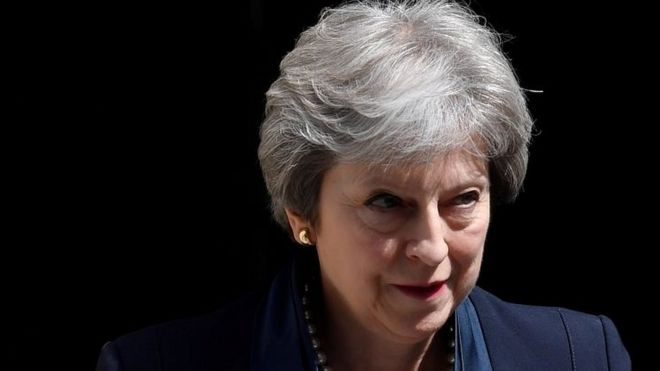
How Do You Solve A Problem Like Theresa?
In one of the better villain lines of cinematic history, James Mason’s character in North By Northwest describes a troublesome adversary as “a matter best disposed of at a great height ... over water”. Would that this expedient solution was available to the Conservative Party which - having missed many opportunities during Theresa May’s Humiliation Tour of Europe over recent months - now faces the ghastly prospect of a Vote Of Confidence.
Events are moving fast; even given the normally ephemeral nature of blogging, Sordel sets finger to keyboard knowing that suspense will be brief and the matter largely settled either today or shortly thereafter. Yet, so rich & aromatic is this smoke for the connoisseur of game theory that it is irrestistable to draw it in and linger over it for a moment before breathing it back into the air to be lost forever.
In terms of tactics nothing should be more simple. The Prime Minister clearly does not carry the confidence of her party. No fewer than a hundred were expected to vote against her Brexit deal had she not put the motion back in her pocket and walked away whistling. If a hundred would oppose in public, it's a reasonable guess that others would oppose given the luxury of a secret ballot. On paper, Brexiters (whose letters largely, if not exclusively, triggered the vote) should vote against her. Remainers should vote against her.
Yet behind these seemingly straightforward decisions there is a lot for a Tory to ponder. Moderate Remainers and Brexiters could probably rally around the current deal to avoid the possibilities of No Deal or a so-called “People’s Vote” (which is just another referendum only this time made less threatening to anyone intimidated by four-syllable words). Hardline Brexiters have to weigh the possibility of wielding the knife yet losing the crown. And noisy Remainers face the exquisite paradox that although they are very keen to extend a vote to the country in general, they are genuinely terrified of putting a choice to their own party membership, who are very likely to impose a Brexiter leader should the vote fall to a free choice between a candidate from one of the party’s two extreme wings.
So although Conservative MPs don’t back Theresa May, there can be very little appetite to remove her. If she wins the vote, she is entitled to stay as leader: she cannot be challenged again for twelve months.
This is the key problem.
For while the parliamentary party might be happy to leave her in place severely wounded, there can be no delight anywhere at the prospect of giving her security of tenure until after Brexit. Unfortunately for her, the Prime Minister is not at all trusted by either wing: putting the Union in jeopardy has alienated even the somewhat Brexit-agnostic to her right; pulling the vote and humiliating the party has enflamed the paranoia of those to her Left to such an extent that it is widely suspected that she is engineering a stealth No Deal. Should either mistrust prove founded, there would be the numbers to support an opposition-led No Confidence vote, but that would be the only way to remove her and they would have to face a General Election whose result is highly uncertain.
The twelve-month moritorium on further votes was introduced to give the leader some security again endless Votes of Confidence, but it may prove to the decisive factor in unseating Mrs. May. A calculating Tory MP on the Remain side might rationally conclude that keeping her in place is hardly worse than having even the most loathed Brexiter in her place. (Indeed, there is a reasonable argument for saying that a loathed Brexiter in her place might be very good for a Remainer, giving considerable cover for moves against future government motions.)
When neither wing has a possible route to victory, it hardly matters what the result is, and that's how Mrs. May got the job in the first place.
[Image copyright: Reuters]
Events are moving fast; even given the normally ephemeral nature of blogging, Sordel sets finger to keyboard knowing that suspense will be brief and the matter largely settled either today or shortly thereafter. Yet, so rich & aromatic is this smoke for the connoisseur of game theory that it is irrestistable to draw it in and linger over it for a moment before breathing it back into the air to be lost forever.
In terms of tactics nothing should be more simple. The Prime Minister clearly does not carry the confidence of her party. No fewer than a hundred were expected to vote against her Brexit deal had she not put the motion back in her pocket and walked away whistling. If a hundred would oppose in public, it's a reasonable guess that others would oppose given the luxury of a secret ballot. On paper, Brexiters (whose letters largely, if not exclusively, triggered the vote) should vote against her. Remainers should vote against her.
Yet behind these seemingly straightforward decisions there is a lot for a Tory to ponder. Moderate Remainers and Brexiters could probably rally around the current deal to avoid the possibilities of No Deal or a so-called “People’s Vote” (which is just another referendum only this time made less threatening to anyone intimidated by four-syllable words). Hardline Brexiters have to weigh the possibility of wielding the knife yet losing the crown. And noisy Remainers face the exquisite paradox that although they are very keen to extend a vote to the country in general, they are genuinely terrified of putting a choice to their own party membership, who are very likely to impose a Brexiter leader should the vote fall to a free choice between a candidate from one of the party’s two extreme wings.
So although Conservative MPs don’t back Theresa May, there can be very little appetite to remove her. If she wins the vote, she is entitled to stay as leader: she cannot be challenged again for twelve months.
This is the key problem.
For while the parliamentary party might be happy to leave her in place severely wounded, there can be no delight anywhere at the prospect of giving her security of tenure until after Brexit. Unfortunately for her, the Prime Minister is not at all trusted by either wing: putting the Union in jeopardy has alienated even the somewhat Brexit-agnostic to her right; pulling the vote and humiliating the party has enflamed the paranoia of those to her Left to such an extent that it is widely suspected that she is engineering a stealth No Deal. Should either mistrust prove founded, there would be the numbers to support an opposition-led No Confidence vote, but that would be the only way to remove her and they would have to face a General Election whose result is highly uncertain.
The twelve-month moritorium on further votes was introduced to give the leader some security again endless Votes of Confidence, but it may prove to the decisive factor in unseating Mrs. May. A calculating Tory MP on the Remain side might rationally conclude that keeping her in place is hardly worse than having even the most loathed Brexiter in her place. (Indeed, there is a reasonable argument for saying that a loathed Brexiter in her place might be very good for a Remainer, giving considerable cover for moves against future government motions.)
When neither wing has a possible route to victory, it hardly matters what the result is, and that's how Mrs. May got the job in the first place.
[Image copyright: Reuters]
Labels:
Brexit,
British Politics,
Conservative Party,
Theresa May,
Tory Party
Thursday, February 1, 2018
Everyone Says I Hate You
The unmasking of Harvey Weinstein (if one can describe as an unmasking the public revelation that what he appeared - on the most cursory of glances - to be was actually what he was) has led to a remarkable wave of self-congratulation in Hollywood. Weinstein, a traditionalist who seemingly regarded the starlets as his own personal seraglio, was, until 2017, doing pretty much what the rest of us thought most producers were doing. Had he not actually attempted to ruin the careers of his more unyielding targets, he would almost certainly have harassed his way into a comfortable retirement. Now he's long gone, and we are told that a new spirit has seized not only the film industry but all other industries, as though some sort of leadership role is automatically conferred to the industry with the most appalling wrongdoers. It's almost like Volkswagen gets to lead the world in anti-Vivisection campaigning.
This has now become a problem for Woody Allen, who has certainly slept with more than one of his leading ladies (Diane Keaton & Mia Farrow to name but two) but not, as far as anyone knows, outside the bounds of strict propriety. And I think that we now would know, because open season has been announced. For the most part this involves the Clintonian defence from actors: they worked with him once, they didn't inhale and they wouldn't do it again. Rebecca Hall, Colin Firth & Mira Sorvino are just some of those doing the walk of shame, apologising for having dared work with him in the first place.
People are choosing to believe that the furore over Allen goes back to 2014, when Dylan Farrow tried (somewhat unsuccessfully) to get actors interested in her renewed accusation that the director had molested her. The reality of the matter is that everyone of an age to remember will recall that these accusations came to light at the time of Allen's separation from Mia Farrow in 1992. So the much-repeated excuse from actors that "I wouldn't have worked with him if I had known then what I now know" rings pretty empty, even were they to know what they are claiming to know. Moreover, even if you set aside the idea that Allen molested one adopted daughter, it is a matter of public record that another adopted daughter - whom he first met at about the age of nine and to whom he owed an unambiguous duty of care - became his sexual partner and subsequently his wife. It's odd to take in one's stride the relationship with Soon-Yi and yet baulk at the accusations regarding Dylan.
These actors posturing over Allen are therefore wrong in two different ways. In the first place, if they are concerned about his sexual biography then they had plenty of reason to avoid him in 1992. If they were worried about the Dylan Farrow accusations, these have been known for as long as many of them have had careers. Yet they were investigated and no prosecution brought at the time. The Law did not sleep over Allen the way that it could be said to have done about other historic accusations. Isn't punishing someone because one believes the legal system to have failed the very definition of Vigilantism?
Greta Gerwig's "come to Jesus" moment was seemingly being nominated for two Academy awards. Gerwig had appeared in the 2012 film To Rome With Love and, like every actor who appears in an Allen-helmed feature, had presumably enjoyed the career boost that comes from inclusion in one of the director's stellar ensembles. It was a useful step up for a young actress, but now her movie Lady Bird is up for several Oscars and, frankly, this is no time to leave dots undotted and crosses uncrossed. So she came out and joined the attack on Allen. She also "guided" another Lady Bird actor, Timothée Chamalet, to donate his fee from another Allen film to charity.
Gerwig doesn't strike me as an activist. Her previous brush with controversy came only last year after she signed a letter opposing an Israeli-backed play. She later climbed down from her support, writing in words that seem especially ironic today that "to put my name to something outside my personal realm of knowledge or experience was a mistake - my mistake - and I am sorry for any confusion or hurt I may have caused'. Her stated positions are at the very least subject to review.
But more worrying than Gerwig herself is what her behaviour says about an industry that was so recently terrorised by Weinstein. If, as Sordel suspects, she fears that insufficient condemnation of Allen may tip the balance in Oscar deliberations, doesn't this show that while the new boss is not the same as the old boss, it is still a boss that governs through terror? Now that Allen's star is seen on the wane it is hardly surprising to see people turn on him. Genuflecting to Power is still the only game in town when L.A. is the town under consideration.
Picture credit to Georges Biard, CC BY-SA 3.0, https://commons.wikimedia.org/w/index.php?curid=49011499
This has now become a problem for Woody Allen, who has certainly slept with more than one of his leading ladies (Diane Keaton & Mia Farrow to name but two) but not, as far as anyone knows, outside the bounds of strict propriety. And I think that we now would know, because open season has been announced. For the most part this involves the Clintonian defence from actors: they worked with him once, they didn't inhale and they wouldn't do it again. Rebecca Hall, Colin Firth & Mira Sorvino are just some of those doing the walk of shame, apologising for having dared work with him in the first place.
People are choosing to believe that the furore over Allen goes back to 2014, when Dylan Farrow tried (somewhat unsuccessfully) to get actors interested in her renewed accusation that the director had molested her. The reality of the matter is that everyone of an age to remember will recall that these accusations came to light at the time of Allen's separation from Mia Farrow in 1992. So the much-repeated excuse from actors that "I wouldn't have worked with him if I had known then what I now know" rings pretty empty, even were they to know what they are claiming to know. Moreover, even if you set aside the idea that Allen molested one adopted daughter, it is a matter of public record that another adopted daughter - whom he first met at about the age of nine and to whom he owed an unambiguous duty of care - became his sexual partner and subsequently his wife. It's odd to take in one's stride the relationship with Soon-Yi and yet baulk at the accusations regarding Dylan.
These actors posturing over Allen are therefore wrong in two different ways. In the first place, if they are concerned about his sexual biography then they had plenty of reason to avoid him in 1992. If they were worried about the Dylan Farrow accusations, these have been known for as long as many of them have had careers. Yet they were investigated and no prosecution brought at the time. The Law did not sleep over Allen the way that it could be said to have done about other historic accusations. Isn't punishing someone because one believes the legal system to have failed the very definition of Vigilantism?
Greta Gerwig's "come to Jesus" moment was seemingly being nominated for two Academy awards. Gerwig had appeared in the 2012 film To Rome With Love and, like every actor who appears in an Allen-helmed feature, had presumably enjoyed the career boost that comes from inclusion in one of the director's stellar ensembles. It was a useful step up for a young actress, but now her movie Lady Bird is up for several Oscars and, frankly, this is no time to leave dots undotted and crosses uncrossed. So she came out and joined the attack on Allen. She also "guided" another Lady Bird actor, Timothée Chamalet, to donate his fee from another Allen film to charity.
Gerwig doesn't strike me as an activist. Her previous brush with controversy came only last year after she signed a letter opposing an Israeli-backed play. She later climbed down from her support, writing in words that seem especially ironic today that "to put my name to something outside my personal realm of knowledge or experience was a mistake - my mistake - and I am sorry for any confusion or hurt I may have caused'. Her stated positions are at the very least subject to review.
But more worrying than Gerwig herself is what her behaviour says about an industry that was so recently terrorised by Weinstein. If, as Sordel suspects, she fears that insufficient condemnation of Allen may tip the balance in Oscar deliberations, doesn't this show that while the new boss is not the same as the old boss, it is still a boss that governs through terror? Now that Allen's star is seen on the wane it is hardly surprising to see people turn on him. Genuflecting to Power is still the only game in town when L.A. is the town under consideration.
Picture credit to Georges Biard, CC BY-SA 3.0, https://commons.wikimedia.org/w/index.php?curid=49011499
Tuesday, August 22, 2017
Era Of Vandals
There's a moment in the movie Die Hard when Hans Gruber, after executing the hapless Harry Ellis whose life he had sought to trade for his stolen detonators, utters to McClane the neglected but immortal line: "Sooner or later, I might get to someone you do care about!"
The war over the Confederate Statues follows the same logic: a war in which - since the point is to provoke - the "Abolitionist" side will always move to the next target in line. Once the statues are gone, the next targets will be "Sweet Home Alabama" & "The Night They Drove Old Dixie Down". Warner Bros. will withdraw Gone With The Wind from sale. After that, Civil War reenactors will be prevented from commemorating any battle won by the Confederacy; then anyone wearing a grey uniform for such purposes will be egged or worse. If you don't care about any of these things, don't worry ... eventually they'll get to something you do care about.
Today's Guardian floats the idea that Nelson's column should be next: it comes complete with a cartoon showing not the statue being removed to a museum, but pulled down, evidently to smash on the ground below. Are you provoked yet? Don't worry, we'll get there.
The author of the article, Afua Hirsch, appeared in the newspaper in 2012 dressed in what Sordel supposes to be traditional Ghanaian clothing and announcing herself as part of the diaspora now returning to the country. During her time there she produced a number of articles of patient virtue including the important (with titles such as Ghana's cashew farmers struggle to share in the profit of their labours & Ghana accuses Environcom of illegal fridge imports) as well as the frothy (Ghana: the new Ibiza for international party set). Now, however, she lives in the UK and writes things designed to upset you and get picked up in social media. Sordel was previously irritated by her article about her experiences as a black student at Oxford but not quite enough to contribute the nutshell's broad readership to her circulation. But she'll get to someone I do care about one of these days.
We in the UK are very on-message about hate speech. It helps that it is prohibited by law of course (no such luck in the U.S.) but it also helps that we don't care about the American Civil War and that the people with the swastikas self-identify as the bad guys. So the Vandals are going to have to go after more central British cultural images: Colston Hall (mentioned of course in Hirsch's article); Admiral Lord Nelson; the Last Night of the Proms. Do you really care about these things, faithful Reader? No, me either.
How are you on the Pre-Raphaelites? All those ivory skins and red hair; an art market explicitly fostered by the profits of the Victorian Age. Alma-Tadema's white-washed vision of the Classical past. Or how about Plato & Aristotle themselves, those idle speculators in a culture propped up by the labour of slaves? Sooner or later ...
The thin end of the edge is already in. Perhaps the seeds of this age of idol-smashing was the fall of Saddam's statue. Sordel watched it live on TV: the all-too-ironic way that a U.S. vehicle tore down the statue because the protestors were unable to tear it down themselves. The symbolism was spot on. But then, last year, one of the Iraqis who was involved gave an interview in which he says that he regretted doing it: "now there are 1000 Saddams". If you don't have anything to put in its place, why destroy anything?
The age of great statuary is over. We can't afford to build new statues even if we could agree on who should be there. There is an empty plinth in
We are in the midst of a slow, relentless replaying of Mao's Cultural Revolution, and as with its precursor it is the young who will execute the policy. Civic pride is a vice of age; irreverence for institutions is a virtue of youth. But these young will be led by those like Hirsch "doing well by doing good". And the Vandals didn't stop at the gates of Rome.
Wednesday, June 14, 2017
The Prisoners of Number Ten
The problem for the Conservative Party is not that it won too few seats, but that it won too many.
Being out of office for a political party is an occupational hazard and in some respects one of those healthy burns that Nature uses to keep a forest growing. Had the Conservatives lost, they could have taken Theresa May out back with that 12-bore reserved for the purpose, and cleanly begun the task of replacing her with a new leader. Boris, encouraged by the thought of years jeering from the Opposition benches at the hapless Corbyn, would joyfully come off the bench, affording both the Tories and the General Public great entertainment without anyone having to risk giving him any actual responsibility.
Moreover, not being in government would be something of a gift right now. Tories on both the Remain & Leave sides could come together to make common cause in criticising whatever slim pickings a Labour government might be able to secure from the EU by way of Brexit settlement. All the problems that currently fall to them would be pushed off onto Labour.
Were Corbyn to underperform against the high standards that he has set himself (as he surely would) he would disappoint the hopes of his younger supporters who would - like every starry-eyed generation of dreamers before them - become cynical inactivists. As it is, they will continue to support Labour in opposition, building a head of steam for the moment when he gets his next chance.
Due to their inconvenient success, the Tories can obtain none of the benefits of second place. Since neither Boris (nor anyone else) wants to lead a minority government tasked with impossible and critical negotiations with the EU, it will be very difficult to replace Theresa May. They are saddled with a lame duck leader who got the job because no one wanted it and will now keep it for precisely the same reason. How long they can tolerate the sight of her limping on with shattered authority is very questionable: John Major pulled it off with some aplomb, but Theresa May is nothing like John Major.
Worse, Tory hands are completely tied: if they opt for a soft Brexit they will be pilloried by their own Eurosceptics & eventually face a General Election at which the votes of former UKIP voters will bleed away; if they opt for a hard Brexit they will be defeated by a grand coalition of the Remainers.
The Tories felt that another period of government would be their reward but it is becoming increasingly obvious that it is actually their punishment.
Being out of office for a political party is an occupational hazard and in some respects one of those healthy burns that Nature uses to keep a forest growing. Had the Conservatives lost, they could have taken Theresa May out back with that 12-bore reserved for the purpose, and cleanly begun the task of replacing her with a new leader. Boris, encouraged by the thought of years jeering from the Opposition benches at the hapless Corbyn, would joyfully come off the bench, affording both the Tories and the General Public great entertainment without anyone having to risk giving him any actual responsibility.
Moreover, not being in government would be something of a gift right now. Tories on both the Remain & Leave sides could come together to make common cause in criticising whatever slim pickings a Labour government might be able to secure from the EU by way of Brexit settlement. All the problems that currently fall to them would be pushed off onto Labour.
Were Corbyn to underperform against the high standards that he has set himself (as he surely would) he would disappoint the hopes of his younger supporters who would - like every starry-eyed generation of dreamers before them - become cynical inactivists. As it is, they will continue to support Labour in opposition, building a head of steam for the moment when he gets his next chance.
Due to their inconvenient success, the Tories can obtain none of the benefits of second place. Since neither Boris (nor anyone else) wants to lead a minority government tasked with impossible and critical negotiations with the EU, it will be very difficult to replace Theresa May. They are saddled with a lame duck leader who got the job because no one wanted it and will now keep it for precisely the same reason. How long they can tolerate the sight of her limping on with shattered authority is very questionable: John Major pulled it off with some aplomb, but Theresa May is nothing like John Major.
Worse, Tory hands are completely tied: if they opt for a soft Brexit they will be pilloried by their own Eurosceptics & eventually face a General Election at which the votes of former UKIP voters will bleed away; if they opt for a hard Brexit they will be defeated by a grand coalition of the Remainers.
The Tories felt that another period of government would be their reward but it is becoming increasingly obvious that it is actually their punishment.
Wednesday, June 7, 2017
The Last Gasp
Compared with the EU Referendum the 2017 UK General Election has been conducted in a spirit of considerable decorum. But then, compared to the EU Referendum, The Jeremy Kyle Show is conducted in a spirit of considerable decorum.
The Conservatives had two ideas at the outset: Jeremy Corbyn can't be trusted with the Brexit negotiations; and, Jeremy Corbyn can't be trusted. (It's one idea really.) In terms of positive campaigning, we have Theresa May's proud adoption of the "bloody difficult woman" nickname (an equivocal compliment at best) and her eleventh hour promise to do away with some of those pesky human rights. Otherwise, the strategy was to keep reminding people that the "leader" of the Labour Party is someone that the Great British Public already dislikes. If Corbyn is unthinkable then May is inevitable.
More significantly, the attacks on Corbyn have largely been matters of fact & record. He's opposed to the use of nuclear weapons and would not authorise a retaliatory strike. He is a Republican sympathiser (both Irish and, for that matter, English) and does not condemn the IRA. He is anti-Israeli and more comfortable than is entirely proper in the company of some of Israel's extremist enemies. He is ideologically wedded to a significant expansion of government spending based on tax-raising calculations that are at best back-of-envelope guesstimates. While Boris Johnson certainly went too far in describing Corbyn as a "friend of Britain's enemies" who "opposed shoot-to-kill" you can say quite a lot against Corbyn without actually having to make stuff up.
Yet precisely because Corbyn is seemingly willing to stand by so many of his past statements, it makes it difficult to use other innuendoes against him. Corbyn is opposed to "shoot-to-kill" in the sense of state-authorised assassination, but he has been unambiguous in his approval of the use of lethal force against terrorists during an incident. He opposes Israel but condemns anti-Semitism: some regard that as an implausible distinction but he doesn't seem to be lying.
On the other hand, there is too much that we don't know about May. Her stated policies - taking apart human rights legislation, taking away free lunches in primary schools, charging directly for social care provision - are, frankly, the stuff of The Left's most paranoid nightmares, yet these are the very measures which the Conservatives hope will enthrall your vote. Not to mention the free vote that they are offering on fox hunting: Sordel doesn't have strong feelings about that one, but it's hardly the most pressing business to which Commons time might be devoted.
Looking at Theresa May it's difficult to argue with the feeling that she has run a "Hillary Clinton" campaign: assuming that she will be elected on the basis that she is clearly the lesser of two evils without offering any sort of social vision around which voters can rally. Public approval of Mrs. May was tepid at the outset: she will be breaking ice to swim in it now.
Whoever wins this week there are dark days ahead since neither Labour (consistently behind in the polls & with an ungovernable parliamentary party) nor the Conservatives (with a badly wounded leader & recovering from a nasty scare in terms of their poll decline) are in the best shape to govern Britain.
On balance, it seems that the most likely winner of this election will be the E.U.
The Conservatives had two ideas at the outset: Jeremy Corbyn can't be trusted with the Brexit negotiations; and, Jeremy Corbyn can't be trusted. (It's one idea really.) In terms of positive campaigning, we have Theresa May's proud adoption of the "bloody difficult woman" nickname (an equivocal compliment at best) and her eleventh hour promise to do away with some of those pesky human rights. Otherwise, the strategy was to keep reminding people that the "leader" of the Labour Party is someone that the Great British Public already dislikes. If Corbyn is unthinkable then May is inevitable.
More significantly, the attacks on Corbyn have largely been matters of fact & record. He's opposed to the use of nuclear weapons and would not authorise a retaliatory strike. He is a Republican sympathiser (both Irish and, for that matter, English) and does not condemn the IRA. He is anti-Israeli and more comfortable than is entirely proper in the company of some of Israel's extremist enemies. He is ideologically wedded to a significant expansion of government spending based on tax-raising calculations that are at best back-of-envelope guesstimates. While Boris Johnson certainly went too far in describing Corbyn as a "friend of Britain's enemies" who "opposed shoot-to-kill" you can say quite a lot against Corbyn without actually having to make stuff up.
Yet precisely because Corbyn is seemingly willing to stand by so many of his past statements, it makes it difficult to use other innuendoes against him. Corbyn is opposed to "shoot-to-kill" in the sense of state-authorised assassination, but he has been unambiguous in his approval of the use of lethal force against terrorists during an incident. He opposes Israel but condemns anti-Semitism: some regard that as an implausible distinction but he doesn't seem to be lying.
On the other hand, there is too much that we don't know about May. Her stated policies - taking apart human rights legislation, taking away free lunches in primary schools, charging directly for social care provision - are, frankly, the stuff of The Left's most paranoid nightmares, yet these are the very measures which the Conservatives hope will enthrall your vote. Not to mention the free vote that they are offering on fox hunting: Sordel doesn't have strong feelings about that one, but it's hardly the most pressing business to which Commons time might be devoted.
Looking at Theresa May it's difficult to argue with the feeling that she has run a "Hillary Clinton" campaign: assuming that she will be elected on the basis that she is clearly the lesser of two evils without offering any sort of social vision around which voters can rally. Public approval of Mrs. May was tepid at the outset: she will be breaking ice to swim in it now.
Whoever wins this week there are dark days ahead since neither Labour (consistently behind in the polls & with an ungovernable parliamentary party) nor the Conservatives (with a badly wounded leader & recovering from a nasty scare in terms of their poll decline) are in the best shape to govern Britain.
On balance, it seems that the most likely winner of this election will be the E.U.
Wednesday, May 17, 2017
The Blame Game
The Independent had some interesting results on public opinion regarding the party leaders. The idea was to compare how much of a net drag the leader's popularity was on the party. Theresa May scored a healthy +6%: of those who liked either her or her party, more liked her than liked her party. Jeremy Corbyn, in marked contrast, scored -24%: of those who liked him or his party, far more liked his party than liked him.
If you were planning the campaign for the Conservative Party, you would probably push May into the spotlight, and this is of course what the Conservatives have done. As campaign planner for the Labour Party you would probably bind & gag Corbyn and lock him in a broom cupboard, yet Labour has also pushed Corbyn into prominence: he, Diane Abbott & John McDonnell have become the three-faced goddess of the Labour campaign.
Partly this is probably recognition from the party leadership that if Corbyn doesn't speak for himself then none of the moderates are likely to speak on his behalf. But it also seems highly likely that the Parliamentary Labour Party - seeing inevitable & swift defeat racing towards them - is isolating Corbyn so that he can become the scapegoat of their collective failure.
Unfortunately for them, this may backfire.
Corbyn cannot win this election, but to a certain extent he doesn't need to. Since the election was announced, Labour has stubbornly risen in the polls from a low point of 24% (probably an outlier) to a high of 32%. Even allowing for errors and the fact that Labour historically performs better in polls than elections, that suggests a 5% rise against a very popular government during a period when most Labour MPs have either been sitting on their hands or publicly saying that Corbyn is poison on the doorstep.
Moreover, the visuals of the campaign are playing into Corbyn's hands. The Prime Minister, attempting to sit on her lead and disinclined to take any risks, has thus far underperformed to what in another election would be an alarming degree. So far, the stories about Theresa May have been about an unconvincing performance as human being on The One Show and an attempt to eat chips sponsored by Photoshop. Her disciplined focus on the phrase strong and stable (which will probably help to win her the election but does nothing to endear her to journalists) only reinforces an impression of tedious stolidity.
Corbyn, however, has made some running. Appearing to cheering crowds of the faithful, he has reinforced the impression that those who like him do so less grudgingly than May's supporters. The likelihood of a landslide against Labour is now all but discounted: Corbyn could come away with a win by showing a roughly equivalent performance to Ed Miliband, which is what current predictions suggest will happen.
After all, there is a lot in this election that is not Corbyn's fault. He cannot be held to account for the collapse of UKIP or the good will currently extended to Theresa May by those who backed Brexit. He's hardly responsible for the fact that the Liberal Democrats (last bastion of the self-proclaimed 48%) are languishing at a dismal 8% of the vote in current predictions. It's difficult to see what he could have done to strengthen Labour in Scotland, where the battle lines seem to have been drawn on The Union & the EU.
It's not entirely impossible that both of the antagonists in this gladiatorial competition will come away with a win.
And whom will Labour MPs (such that remain) blame then?
If you were planning the campaign for the Conservative Party, you would probably push May into the spotlight, and this is of course what the Conservatives have done. As campaign planner for the Labour Party you would probably bind & gag Corbyn and lock him in a broom cupboard, yet Labour has also pushed Corbyn into prominence: he, Diane Abbott & John McDonnell have become the three-faced goddess of the Labour campaign.
Partly this is probably recognition from the party leadership that if Corbyn doesn't speak for himself then none of the moderates are likely to speak on his behalf. But it also seems highly likely that the Parliamentary Labour Party - seeing inevitable & swift defeat racing towards them - is isolating Corbyn so that he can become the scapegoat of their collective failure.
Unfortunately for them, this may backfire.
Corbyn cannot win this election, but to a certain extent he doesn't need to. Since the election was announced, Labour has stubbornly risen in the polls from a low point of 24% (probably an outlier) to a high of 32%. Even allowing for errors and the fact that Labour historically performs better in polls than elections, that suggests a 5% rise against a very popular government during a period when most Labour MPs have either been sitting on their hands or publicly saying that Corbyn is poison on the doorstep.
Moreover, the visuals of the campaign are playing into Corbyn's hands. The Prime Minister, attempting to sit on her lead and disinclined to take any risks, has thus far underperformed to what in another election would be an alarming degree. So far, the stories about Theresa May have been about an unconvincing performance as human being on The One Show and an attempt to eat chips sponsored by Photoshop. Her disciplined focus on the phrase strong and stable (which will probably help to win her the election but does nothing to endear her to journalists) only reinforces an impression of tedious stolidity.
Corbyn, however, has made some running. Appearing to cheering crowds of the faithful, he has reinforced the impression that those who like him do so less grudgingly than May's supporters. The likelihood of a landslide against Labour is now all but discounted: Corbyn could come away with a win by showing a roughly equivalent performance to Ed Miliband, which is what current predictions suggest will happen.
After all, there is a lot in this election that is not Corbyn's fault. He cannot be held to account for the collapse of UKIP or the good will currently extended to Theresa May by those who backed Brexit. He's hardly responsible for the fact that the Liberal Democrats (last bastion of the self-proclaimed 48%) are languishing at a dismal 8% of the vote in current predictions. It's difficult to see what he could have done to strengthen Labour in Scotland, where the battle lines seem to have been drawn on The Union & the EU.
It's not entirely impossible that both of the antagonists in this gladiatorial competition will come away with a win.
And whom will Labour MPs (such that remain) blame then?
Friday, May 12, 2017
"Have You No Sense Of Decency Sir?"
Amongst the electrifying moments of political history, one of the most memorable is surely Joseph N. Welch's response to Joe McCarthy. Welch, Chief Counsel to the U.S. Army at a time when it was being investigated by Senate Committee on Investigations, had turned the table on McCarthy wth allegations of cronyism. In response, McCarthy sought to blacken the name of a young attorney in Welch's own firm who had previously been a member of a professional organisation deemed to have Communist leanings, prompting Welch's famous rebuke: "Have you no sense of decency Sir?"
Sordel doesn't have a vote in U.S. elections but can hardly be imagined to be a Republican sympathiser in general or someone who would make common cause with Donald Trump. That said, it has become increasingly clear that someone needs to ask Trump's opponents Welch's question. Have they no decency? Is there nothing to which they will not stoop to blacken the man's name?
For years we were rightly told by Democrats that there was something troubling about the so-called "birther" lie that Barack Obama had been born in Kenya rather than Hawaii and was therefore ineligible to become President. To be sure, it was problematic accusation since what seemed like a nice legal point also had a discernible undercurrent of racism. But where a person is born is rather beyond their control. Had Obama been born in Kenya, it would not have amounted to a fault, merely a technical disqualification.
Donald Trump, however, has been branded "a self-confessed molester of women", someone with an incestuous passion for his daughter, a crook, a "vile misogynist", a "Russian stooge" & someone already convicted in court of public opinion of treason.
There are those amongst these accusations which are thin in the extreme: for example, an Australian politician's claim that Trump is a "self-confessed molester of women and [has] green-lighted sexual assaults" is obvious nonsense. Trump never said that he had personally grabbed women by the pussy, made it clear that consent was granted ("they let you do anything"), claimed this dubious privilege only for a "star" (not your regular working stiff) and can hardly have been said to give the green light for anything in a private conversation. Trump may, in fact, be a molester for all Sordel knows (there have been occasional stories but surprisingly few for a man who was going about shaking hands with completely the wrong part of a woman's anatomy) but all Sordel knows in this case is pretty much all that you, Constant Reader, know.
If any of these allegations against Trump were true, it would be a big deal, but it has become increasingly clear that the anti-Trump movement doesn't care.
Consider the treason allegation. In some fanciful minds (not all those who use the term, but certainly some) Russia decided to "turn" a TV celebrity notably lacking in even the most elementary espionage skills (such as discretion), ran him in a presidential campaign that he seemed all but certain to lose and then "rigged" the election so that they could have their man in The White House. Prima facie evidence of collusion is very, very, very thin and it is important to bear in mind that - even if the Russians did, as supposed, hack the DNC servers and leak the results in a bid to turn the course of the election - those leaks actually had virtually no effect on public opinion during the Presidential election, being completely dwarfed in importance by a great many other factors. Among those factors was another leak: the leak of Trump's "Pussygate" conversation, which no one seems to object to in the least despite the fact that there was a clearer public interest for the publication of the DNC leak than there was for the Pussygate one. (And yes, a leak orchestrated on the basis of an illegal operation by a foreign country would, of course, be different from a leak by a U.S. citizen but nonetheless, there is a double standard at work here.)
It is not Sordel's business to determine whether Trump is, in fact, a Russian sleeper agent or a misogynist etc. etc. That's not my point. My point is that with Trump a psychological point seems to have been crossed at which what people are prepared to say about a sitting President is no longer innuendo about where he was born or what religion he follows in secret. Now it's everything you can possibly say about another human being, whatever the evidence. Often the people who say these things hardly seem to believe them, resorting to the childish excuse that "they started it." If you value Truth at all, then your valuation should not change depending on how much your opponent lies.
What route is there forward for the U.S. now? What businessman will ever stand for the Presidency again? Why would next election's losers ever hold themselves to a higher standard than the last election's losers? Whatever happened to the fundamental decency of the Left?
Or are they just all Joe McCarthy now?
Sordel doesn't have a vote in U.S. elections but can hardly be imagined to be a Republican sympathiser in general or someone who would make common cause with Donald Trump. That said, it has become increasingly clear that someone needs to ask Trump's opponents Welch's question. Have they no decency? Is there nothing to which they will not stoop to blacken the man's name?
For years we were rightly told by Democrats that there was something troubling about the so-called "birther" lie that Barack Obama had been born in Kenya rather than Hawaii and was therefore ineligible to become President. To be sure, it was problematic accusation since what seemed like a nice legal point also had a discernible undercurrent of racism. But where a person is born is rather beyond their control. Had Obama been born in Kenya, it would not have amounted to a fault, merely a technical disqualification.
Donald Trump, however, has been branded "a self-confessed molester of women", someone with an incestuous passion for his daughter, a crook, a "vile misogynist", a "Russian stooge" & someone already convicted in court of public opinion of treason.
There are those amongst these accusations which are thin in the extreme: for example, an Australian politician's claim that Trump is a "self-confessed molester of women and [has] green-lighted sexual assaults" is obvious nonsense. Trump never said that he had personally grabbed women by the pussy, made it clear that consent was granted ("they let you do anything"), claimed this dubious privilege only for a "star" (not your regular working stiff) and can hardly have been said to give the green light for anything in a private conversation. Trump may, in fact, be a molester for all Sordel knows (there have been occasional stories but surprisingly few for a man who was going about shaking hands with completely the wrong part of a woman's anatomy) but all Sordel knows in this case is pretty much all that you, Constant Reader, know.
If any of these allegations against Trump were true, it would be a big deal, but it has become increasingly clear that the anti-Trump movement doesn't care.
Consider the treason allegation. In some fanciful minds (not all those who use the term, but certainly some) Russia decided to "turn" a TV celebrity notably lacking in even the most elementary espionage skills (such as discretion), ran him in a presidential campaign that he seemed all but certain to lose and then "rigged" the election so that they could have their man in The White House. Prima facie evidence of collusion is very, very, very thin and it is important to bear in mind that - even if the Russians did, as supposed, hack the DNC servers and leak the results in a bid to turn the course of the election - those leaks actually had virtually no effect on public opinion during the Presidential election, being completely dwarfed in importance by a great many other factors. Among those factors was another leak: the leak of Trump's "Pussygate" conversation, which no one seems to object to in the least despite the fact that there was a clearer public interest for the publication of the DNC leak than there was for the Pussygate one. (And yes, a leak orchestrated on the basis of an illegal operation by a foreign country would, of course, be different from a leak by a U.S. citizen but nonetheless, there is a double standard at work here.)
It is not Sordel's business to determine whether Trump is, in fact, a Russian sleeper agent or a misogynist etc. etc. That's not my point. My point is that with Trump a psychological point seems to have been crossed at which what people are prepared to say about a sitting President is no longer innuendo about where he was born or what religion he follows in secret. Now it's everything you can possibly say about another human being, whatever the evidence. Often the people who say these things hardly seem to believe them, resorting to the childish excuse that "they started it." If you value Truth at all, then your valuation should not change depending on how much your opponent lies.
What route is there forward for the U.S. now? What businessman will ever stand for the Presidency again? Why would next election's losers ever hold themselves to a higher standard than the last election's losers? Whatever happened to the fundamental decency of the Left?
Or are they just all Joe McCarthy now?
Wednesday, May 3, 2017
Ghosts of the Barely Civil Undead
If the media consensus is to be believed the UK currently finds itself in middle of an election campaign that has been greeted with public apathy. Presumably, voters are bored for the same reason that shooting fish in a barrel never caught on as a spectator sport: rather than sportingly let her opponents get a head start in the renewed race for number ten, Theresa May called the election when she already had a considerable poll lead.
Unfortunately, bored journalists looking to make a story out of nothing have two sources of potential headlines close at hand: Tony Blair & George Osborne.
Blair's so-called return to politics is, of course, nothing of the sort. He has been a constant feature of the political landscape for the last year: he campaigned against both the Brexit side of referendum & Jeremy Corbyn's leadership of the Labour with all the determination of a man who has been on the wrong side of public opinion before and will be damned if he doesn't place himself on the wrong side of it again. Blair is not so much back as ever with us like the poor, and that era of foreign wars of which he was a principal architect.
Osborne, on the other hand, has been licking his wounds since last July. He is a man with a very particular claim to fame, having lead a campaign that failed to secure a Remain vote in the referendum despite having all three governing parties (&, for that matter, the SNP) on his side. As if that failure was not feather enough in his cap he is then reputed to have attempted to have May removed from her post at the Home Office as punishment for her failure to support his campaign more full-throatedly, laying the ground for a splendid reversal of fortunes of the sort more usually found in Game of Thrones.
Last September, it was reported that Osborne was attempting to cast himself as "the Tory opposition to Hard Brexit" and "revealed" that he was "considering a return to front line politics". All very "Tony Blair", who has been threatening something similar in an attempt to hold the media spotlight.
Now, however, Osborne has availed himself of a pulpit somewhat different from the anonymity of the back benches, as he has become the editor of the London Evening Standard, a paper that was described at one point as "a mouthpiece of the Conservative Party" but which has now recovered some measure of independence by trashing May's campaign (by no means unfairly) for its reliance on sloganeering above policy detail.
So here we have two senior politicians - both, in some measure, great successes & stupefying failures - who have decided to bring the force of their debatable insight to bear upon the leaders of their respective parties. Blair is trying to work up some enthusiasm for tactical voting & a progressive alliance; Osborne is sniping at the woman who sacked him, arguably in the hope that he can speed the Wheel of Fortune's inevitable turn towards the moment when he can inherit the party to which he is currently showing disputable loyalty.
Yet neither of these men wishes to serve. They airily speak of returning to politics, but not the politics of constituency surgeries, just the politics of enjoying an unelected vantage point for commentary. They are perfect representatives of the political class that played duck & cover when the EU referendum backfired: the class of which Boris and Cameron are also such perfect examples. They know all about cars just as long as they are kicking someone else's tyres.
And when it comes to unelected vantage points for commentary, the line forms behind Sordel.
Unfortunately, bored journalists looking to make a story out of nothing have two sources of potential headlines close at hand: Tony Blair & George Osborne.
Blair's so-called return to politics is, of course, nothing of the sort. He has been a constant feature of the political landscape for the last year: he campaigned against both the Brexit side of referendum & Jeremy Corbyn's leadership of the Labour with all the determination of a man who has been on the wrong side of public opinion before and will be damned if he doesn't place himself on the wrong side of it again. Blair is not so much back as ever with us like the poor, and that era of foreign wars of which he was a principal architect.
Osborne, on the other hand, has been licking his wounds since last July. He is a man with a very particular claim to fame, having lead a campaign that failed to secure a Remain vote in the referendum despite having all three governing parties (&, for that matter, the SNP) on his side. As if that failure was not feather enough in his cap he is then reputed to have attempted to have May removed from her post at the Home Office as punishment for her failure to support his campaign more full-throatedly, laying the ground for a splendid reversal of fortunes of the sort more usually found in Game of Thrones.
Last September, it was reported that Osborne was attempting to cast himself as "the Tory opposition to Hard Brexit" and "revealed" that he was "considering a return to front line politics". All very "Tony Blair", who has been threatening something similar in an attempt to hold the media spotlight.
Now, however, Osborne has availed himself of a pulpit somewhat different from the anonymity of the back benches, as he has become the editor of the London Evening Standard, a paper that was described at one point as "a mouthpiece of the Conservative Party" but which has now recovered some measure of independence by trashing May's campaign (by no means unfairly) for its reliance on sloganeering above policy detail.
So here we have two senior politicians - both, in some measure, great successes & stupefying failures - who have decided to bring the force of their debatable insight to bear upon the leaders of their respective parties. Blair is trying to work up some enthusiasm for tactical voting & a progressive alliance; Osborne is sniping at the woman who sacked him, arguably in the hope that he can speed the Wheel of Fortune's inevitable turn towards the moment when he can inherit the party to which he is currently showing disputable loyalty.
Yet neither of these men wishes to serve. They airily speak of returning to politics, but not the politics of constituency surgeries, just the politics of enjoying an unelected vantage point for commentary. They are perfect representatives of the political class that played duck & cover when the EU referendum backfired: the class of which Boris and Cameron are also such perfect examples. They know all about cars just as long as they are kicking someone else's tyres.
And when it comes to unelected vantage points for commentary, the line forms behind Sordel.
Monday, September 26, 2016
Lore Of The Excluded Centre
People have a tendency to put cast their ultimata by using that very useful small word: or. "Back me or sack me." "Put up or shut up." "Go big or go home." But The Labour Party currently has got itself into a position where ors no longer seem to count for anything.
Things began badly when the Parliamentary Labour Party discovered that it wouldn't back Jeremy Corbyn and couldn't sack him either. Let's be clear: if Corbyn was on fire and the greater proportion of his MPs had uncomfortably full bladders then they would burst before they assuaged the least part of his discomfort. Backing Corbyn was out of the question, but the manoeuvres to remove him backfired almost beyond belief. Corbyn now has a tame Shadow Cabinet and a renewed mandate; his opponents have given up their cabinet positions (with such dubious eminence as these conferred upon them) and been forced to slink to the back benches where - due to the paucity of MPs willing to sit any closer to their leader than absolutely necessary - they are presumably packed like a small wardrobe towards the end of a particularly populous game of Sardines.
Next, they decided that they wouldn't shut up, but weren't going to put up either. None of Corbyn's most vocal detractors actually stood against him in the leadership election with the consequence that the job of running against him fell to a man more anonymous than his surname; a man, in fact, whose only discernible political achievement had been to trip the hapless Angela Eagle as she stretched out for the prize. The Labour Big Beasts hung back, hoping to dine on another's kill, and all that is left for them now is dispute the pickings of Owen Smith's lean & hungry carcass.
Now it is left for them to go big or go home. But going big is going to be difficult: a vote of No Confidence is difficult to top, and the near unanimity with which the Parliamentary Labour Party attempted to remove Corbyn looks considerably more fragile today.
And, given the difficult conversations that they face with their constituency party members, Labour MPs can't go home.
So it comes down to that most famous of literary disjunctions: "To be or not to be." True, collective self-destruction seems to be option for which Labour MPs have boundless appetite, but this seems to be a case where even making their quietus with a bare bodkin can hardly spare them a proud man's contumely.
Things began badly when the Parliamentary Labour Party discovered that it wouldn't back Jeremy Corbyn and couldn't sack him either. Let's be clear: if Corbyn was on fire and the greater proportion of his MPs had uncomfortably full bladders then they would burst before they assuaged the least part of his discomfort. Backing Corbyn was out of the question, but the manoeuvres to remove him backfired almost beyond belief. Corbyn now has a tame Shadow Cabinet and a renewed mandate; his opponents have given up their cabinet positions (with such dubious eminence as these conferred upon them) and been forced to slink to the back benches where - due to the paucity of MPs willing to sit any closer to their leader than absolutely necessary - they are presumably packed like a small wardrobe towards the end of a particularly populous game of Sardines.
Next, they decided that they wouldn't shut up, but weren't going to put up either. None of Corbyn's most vocal detractors actually stood against him in the leadership election with the consequence that the job of running against him fell to a man more anonymous than his surname; a man, in fact, whose only discernible political achievement had been to trip the hapless Angela Eagle as she stretched out for the prize. The Labour Big Beasts hung back, hoping to dine on another's kill, and all that is left for them now is dispute the pickings of Owen Smith's lean & hungry carcass.
Now it is left for them to go big or go home. But going big is going to be difficult: a vote of No Confidence is difficult to top, and the near unanimity with which the Parliamentary Labour Party attempted to remove Corbyn looks considerably more fragile today.
And, given the difficult conversations that they face with their constituency party members, Labour MPs can't go home.
So it comes down to that most famous of literary disjunctions: "To be or not to be." True, collective self-destruction seems to be option for which Labour MPs have boundless appetite, but this seems to be a case where even making their quietus with a bare bodkin can hardly spare them a proud man's contumely.
Labels:
Hamlet,
Jeremy Corbyn,
Labour Party,
Owen Smith,
Parliament
Sunday, July 24, 2016
Owen Goal
If we believe the polls (which, of course, we shouldn't) Owen Smith is all-in & drawing dead in his bid to replace Jeremy Corbyn as Labour leader. Smith has hitherto not troubled these (or any other) pages, but has nonetheless been anointed as the brightest & best that the Parliamentary Labour Party has to offer which, unfortunately, is not hard to believe. In an article based on interviews with constituency party members The Guardian sheepishly revealed that no one really had a word to say about Smith whose main drawback is also his key virtue: anonymity. The assumption by Labour MPs, for better or worse, is that the least known of them is probably also the one least hated by Labour's members.
Although Smith is regarded as "soft Left" however, there is nothing soft about the approach that he is taking as his campaign ratchets up. And this is a problem.
His lines of attack are familiar: surrounding himself with women, he has branded himself as the sexual equality candidate while female Labour MPs have pushed the narrative that Corbyn is not doing enough to quell the abuse that his less evolved supporters are flinging at them. Surely the next step will be for Smith to reveal Jewish endorsements while saying that Corbyn has failed to confront the anti-Semitism of the Left. He will pose with British soldiers while saying that Corbyn is weak on security. He will appear at Battersea Dogs' Home to criticise Corbyn's lack of a full-voiced opposition to mistreatment of animals.
And the problem in all this is not for Corbyn but for the very people who want to unseat him, because Smith is effectively re-running the tactics of the failed Remain campaign: relentlessly attacking the very voters whom you expect to deliver your victory.
Brexit voters were treated as credulous & racist. This is the strategy used during the EU referendum campaign, and in that context it is worth remembering that MP Jo Cox was actually murdered: powerful proof that at least some Brexit adherents seemed to be exactly what the Remainers were claiming.
Yet an event that might have been expected to swing the entire course of the Referendum, in the end, did not turn the tide, and possibly for the same reason that Smith's strategy is doomed. People's attitudes had been hardened by weeks of abuse, to the point at which they were no longer willing to give any credence at all to the people who were trying to persuade them.
Right now there is no accusation that could be flung at Jeremy Corbyn that people are likely to believe: especially if they continue along the same lines as today's tale of a Watergate-style office break-in. It looks at first appearance like a stunt at best and a blatant smear at worst.
It may well be impossible for Smith to engage with the Labour rank & file but for sure he will not do it by pursuing his current path.
Although Smith is regarded as "soft Left" however, there is nothing soft about the approach that he is taking as his campaign ratchets up. And this is a problem.
His lines of attack are familiar: surrounding himself with women, he has branded himself as the sexual equality candidate while female Labour MPs have pushed the narrative that Corbyn is not doing enough to quell the abuse that his less evolved supporters are flinging at them. Surely the next step will be for Smith to reveal Jewish endorsements while saying that Corbyn has failed to confront the anti-Semitism of the Left. He will pose with British soldiers while saying that Corbyn is weak on security. He will appear at Battersea Dogs' Home to criticise Corbyn's lack of a full-voiced opposition to mistreatment of animals.
And the problem in all this is not for Corbyn but for the very people who want to unseat him, because Smith is effectively re-running the tactics of the failed Remain campaign: relentlessly attacking the very voters whom you expect to deliver your victory.
Brexit voters were treated as credulous & racist. This is the strategy used during the EU referendum campaign, and in that context it is worth remembering that MP Jo Cox was actually murdered: powerful proof that at least some Brexit adherents seemed to be exactly what the Remainers were claiming.
Yet an event that might have been expected to swing the entire course of the Referendum, in the end, did not turn the tide, and possibly for the same reason that Smith's strategy is doomed. People's attitudes had been hardened by weeks of abuse, to the point at which they were no longer willing to give any credence at all to the people who were trying to persuade them.
Right now there is no accusation that could be flung at Jeremy Corbyn that people are likely to believe: especially if they continue along the same lines as today's tale of a Watergate-style office break-in. It looks at first appearance like a stunt at best and a blatant smear at worst.
It may well be impossible for Smith to engage with the Labour rank & file but for sure he will not do it by pursuing his current path.
Wednesday, July 13, 2016
A Laboured Analogy
The Parliamentary Labour Party makes for a lousy boyfriend.
For a start, he always expects you to pay for his round, and he's always playing Lord Bountiful: treating everyone who comes into the pub, whispering to you that all this "networking" is really going to pay off down the line. Though whether it will be paying off for the both of you, or just for him, is a bit difficult to tell.
Then, he always seems to be gossiping about you with his friends. He tells them that you're a bit dumb, and boring, and whiny ... even that you're a bit anti-Semitic, which he seems to think makes him look enlightened & tolerant in mixed company.
Worst of all, he's always making a spectacle of himself chasing after other women. Every few years you'll find him making a play for some stray piece of skirt, even though he knows full well that she prefers the posh boy with the nice car from up the street. He'll put on his best suit, which doesn't even fit him, take her up West and, from what you've heard, make out that you and he broke up years ago.
Of course, once she's dumped him (like she always does) he's back, telling you that he should have listened to you more and say if you let him back then it'll all be different this time. He'll even go to the restaurant you choose before the pub on Friday night. Except, when you do choose, he sits there sulking through the starter and then says that he'd be eating his favourite bhuna by now if he'd made the choice for you.
Then he says that no real girlfriend would have made him eat this filthy Greek muck in the first place: you only do it to annoy him and if he wanted to eat goats cheese he'd have been a goat. And he's had it with you and your fucking stupid ideas of where to eat and you'd better get your coat you dumb bitch because he's off for a bhuna and if you don't like it you can lump it, see?
And when you tell him that you haven't even had your moussaka yet and you were looking forward to it he tells you: "Look, the moussaka's off, no moussaka, this restaurant's a bust. All of my friends keep telling me: there is no fucking moussaka, okay? I'm not sitting here to find out whether some fucking moussaka that doesn't even exist warps into existence and appears on a plate in front of you, because I'm pretty sure that if I get to the pub by nine tonight then that girl from up the road is going to be there, gagging for it."
But this time you tell him: no, she's not gagging for it because she's going steady with that other guy, and the other guy says he's keeping her until 2020 so you can whistle for your bhuna, Parliamentary Labour Party.
And he just looks at you. That look. That look that says "if I have to eat Greek salad one more time and look at your stupid face I'll kill myself".
So that night you throw a brick through his window, obviously.
For a start, he always expects you to pay for his round, and he's always playing Lord Bountiful: treating everyone who comes into the pub, whispering to you that all this "networking" is really going to pay off down the line. Though whether it will be paying off for the both of you, or just for him, is a bit difficult to tell.
Then, he always seems to be gossiping about you with his friends. He tells them that you're a bit dumb, and boring, and whiny ... even that you're a bit anti-Semitic, which he seems to think makes him look enlightened & tolerant in mixed company.
Worst of all, he's always making a spectacle of himself chasing after other women. Every few years you'll find him making a play for some stray piece of skirt, even though he knows full well that she prefers the posh boy with the nice car from up the street. He'll put on his best suit, which doesn't even fit him, take her up West and, from what you've heard, make out that you and he broke up years ago.
Of course, once she's dumped him (like she always does) he's back, telling you that he should have listened to you more and say if you let him back then it'll all be different this time. He'll even go to the restaurant you choose before the pub on Friday night. Except, when you do choose, he sits there sulking through the starter and then says that he'd be eating his favourite bhuna by now if he'd made the choice for you.
Then he says that no real girlfriend would have made him eat this filthy Greek muck in the first place: you only do it to annoy him and if he wanted to eat goats cheese he'd have been a goat. And he's had it with you and your fucking stupid ideas of where to eat and you'd better get your coat you dumb bitch because he's off for a bhuna and if you don't like it you can lump it, see?
And when you tell him that you haven't even had your moussaka yet and you were looking forward to it he tells you: "Look, the moussaka's off, no moussaka, this restaurant's a bust. All of my friends keep telling me: there is no fucking moussaka, okay? I'm not sitting here to find out whether some fucking moussaka that doesn't even exist warps into existence and appears on a plate in front of you, because I'm pretty sure that if I get to the pub by nine tonight then that girl from up the road is going to be there, gagging for it."
But this time you tell him: no, she's not gagging for it because she's going steady with that other guy, and the other guy says he's keeping her until 2020 so you can whistle for your bhuna, Parliamentary Labour Party.
And he just looks at you. That look. That look that says "if I have to eat Greek salad one more time and look at your stupid face I'll kill myself".
So that night you throw a brick through his window, obviously.
Monday, June 27, 2016
Go To Your Happy Place
At a time when Plan B is desperately needed - when UK MPs are required to process the narrow but unambiguous rejection of their advice and get on with the job that they were elected to do - those who have found it easiest to adjust are the ones who are just pushing Plan A. The SNP (led by the person who is currently probably today the UK's most popular politician on any side: pocket dynamo Nicola Sturgeon) thinks that Scottish Independence may be the answer. Sinn Féin feels that Irish Independence may do the trick. Conservative MPs are getting down to the serious business of trying to stop Boris Johnson getting to Number 10. And Labour MPs are trying to remove Jeremy Corbyn.
Removing Jeremy Corbyn is, of course, not so much the Plan A of Labour MPs as the One Plan To Rule Them All. Since this mild-mannered and rather bland specimen of Far Left extremism was foisted on them by the contemptible rank & file they have been waiting on the steps of the capitol with a murderous gleam in their collective eye hoping to catch sight of him cycling by, but have been repeatedly cheated of their prey. They were already to pounce after the Oldham West & Royton by-election last year (which confounded their hopes by resulting in a ringing Labour victory) and almost did so at the time of the underwhelming council election results in May. Had he delivered in terms of the election failure that all Labour MPs so clearly covet, he would have been gone by now.
Under the circumstances, the Parliamentary Labour Party has picked now as its time to strike (if strike be quite the word for the centrist wing of the party with its inherent mistrust of unions). Seemingly, the EU referendum result is to be laid at his door due to the tepidity with which he campaigned for a Remain victory.
Well, that's the ostensible reason at least.
Setting aside for now the question about whether changing the leader is wise at such a time of convulsion, what is the benefit to the party to remove anyone, let alone the leader, on the basis of a lack of Euro-enthusiasm? Broadly there are two options: Brexit or a rejection of the Brexit vote by the political elites. If the political elites refuse to enact Brexit (which may still happen) then it doesn't really matter where people were on the referendum. On the other hand, if Brexit is going to be enacted then it will require Brexiters, Bremainers and everyone between those two camps to come to the aid of the country.
Labour can turn itself into the perfect pro-Bremain party, but that transformation will be too late to be anything but position the party on the other side of the question from the majority view of its voters, and any leader palatable to the PLP will almost certainly be someone whose wisdom on the question has just been rejected by the electorate.
Of course, Labour MPs are not thinking straight at all. They know that Cameron is going, that a general election may be years closer at hand than expected and that the bloody business of decapitation needs to be done now. In response to the crisis, they have gone to their happy place not by means of calm meditation & positive visualisation but with a massive intracardiac injection of whatever high-potency variant of cocaine fuels them. They think that - like Mia Wallace in Pulp Fiction - all they will do is thrash around the floor for a second and sit bolt upright with everything alright again.
Except - like Mia Wallace in Pulp Fiction - what they think is cocaine may be a fatal overdose of something else.
Removing Jeremy Corbyn is, of course, not so much the Plan A of Labour MPs as the One Plan To Rule Them All. Since this mild-mannered and rather bland specimen of Far Left extremism was foisted on them by the contemptible rank & file they have been waiting on the steps of the capitol with a murderous gleam in their collective eye hoping to catch sight of him cycling by, but have been repeatedly cheated of their prey. They were already to pounce after the Oldham West & Royton by-election last year (which confounded their hopes by resulting in a ringing Labour victory) and almost did so at the time of the underwhelming council election results in May. Had he delivered in terms of the election failure that all Labour MPs so clearly covet, he would have been gone by now.
Under the circumstances, the Parliamentary Labour Party has picked now as its time to strike (if strike be quite the word for the centrist wing of the party with its inherent mistrust of unions). Seemingly, the EU referendum result is to be laid at his door due to the tepidity with which he campaigned for a Remain victory.
Well, that's the ostensible reason at least.
Setting aside for now the question about whether changing the leader is wise at such a time of convulsion, what is the benefit to the party to remove anyone, let alone the leader, on the basis of a lack of Euro-enthusiasm? Broadly there are two options: Brexit or a rejection of the Brexit vote by the political elites. If the political elites refuse to enact Brexit (which may still happen) then it doesn't really matter where people were on the referendum. On the other hand, if Brexit is going to be enacted then it will require Brexiters, Bremainers and everyone between those two camps to come to the aid of the country.
Labour can turn itself into the perfect pro-Bremain party, but that transformation will be too late to be anything but position the party on the other side of the question from the majority view of its voters, and any leader palatable to the PLP will almost certainly be someone whose wisdom on the question has just been rejected by the electorate.
Of course, Labour MPs are not thinking straight at all. They know that Cameron is going, that a general election may be years closer at hand than expected and that the bloody business of decapitation needs to be done now. In response to the crisis, they have gone to their happy place not by means of calm meditation & positive visualisation but with a massive intracardiac injection of whatever high-potency variant of cocaine fuels them. They think that - like Mia Wallace in Pulp Fiction - all they will do is thrash around the floor for a second and sit bolt upright with everything alright again.
Except - like Mia Wallace in Pulp Fiction - what they think is cocaine may be a fatal overdose of something else.
Labels:
David Cameron,
EU,
Jeremy Corbyn,
Labour Party,
Nicola Sturgeon,
Referendum,
SNP
Friday, June 24, 2016
Careful What You Wish For
Like participants in an especially hedonistic stag party, UK voters awakened today to the challenge of distinguishing reality from the ghastly fever dream that had troubled their sleep. A dawning realisation will be transferred from face to face as people pass one another on the street and look nervously away. By God, it's true, we did that.
That (for those tripping over this very small corner of the internet whilst looking for something else in years to come) is this: the UK voted to leave the EU. Yes, the Little Train That Couldn't, did, and it turns out that Casey Jones was at the engine, going full steam to catastrophe.
When many of us went to bed last night we did so in a markedly different world: Farage had reputedly conceded; David Dimbleby had announced that the pro-EU campaign seemed to have prevailed; and even the pro-Leave talking heads seemed to think that the issue had been settled for the status quo. This consensus, however, was based on the idea that a large turnout would favour Remain: a narrative that was at odds with what many were saying about the demographic of their supporters. If those who vote Remain are the most educated, metropolitan, Guardian-reading members of society, aren't these the people who reliably vote in every election? Who were these other people registering and voting in large numbers? Why was the assumption that people who took too little interest in politics to vote in a General Election were suddenly rallying to the flag of the European Union?
The reality of the matter - that the Leave campaign had prevailed on the basis of a massive turnout - has proven to be a national act of civil disobedience. The vice anglais was well-named: the British people has cast aside its safe word and asking to be whipped a little harder please Miss. We're often told in the political context that turkeys don't vote for Christmas, yet the UK electorate has basted itself, cooked itself to perfection and has a saucière of cranberry sauce balanced on its left wing.
Quite why that is we will probably never know because the votes that swung this referendum are not the votes that we could see (the active, UKIP-voting people of Middle England who could be heard on every radio debate prior to voting day) but the votes that we couldn't: the quiet, unannounced votes that tipped the balance.
But if you're looking around today for someone to blame in the weeks, months, perhaps years to come, it's worth bearing in mind that the referendum only took place due to a cynical piece of manoeuvring from the man who professed to want it least. David Cameron jeopardised (History may say "sacrificed") his entire nation solely to minimise the UKIP vote at the last General Election, promising a referendum that would/could never pass in a bid to cling to power. On the morning after the night before, he proved to be not the result's only - but certainly its most prominent - casualty.
If the poets have tragedies yet to write then let them ponder that.
That (for those tripping over this very small corner of the internet whilst looking for something else in years to come) is this: the UK voted to leave the EU. Yes, the Little Train That Couldn't, did, and it turns out that Casey Jones was at the engine, going full steam to catastrophe.
When many of us went to bed last night we did so in a markedly different world: Farage had reputedly conceded; David Dimbleby had announced that the pro-EU campaign seemed to have prevailed; and even the pro-Leave talking heads seemed to think that the issue had been settled for the status quo. This consensus, however, was based on the idea that a large turnout would favour Remain: a narrative that was at odds with what many were saying about the demographic of their supporters. If those who vote Remain are the most educated, metropolitan, Guardian-reading members of society, aren't these the people who reliably vote in every election? Who were these other people registering and voting in large numbers? Why was the assumption that people who took too little interest in politics to vote in a General Election were suddenly rallying to the flag of the European Union?
The reality of the matter - that the Leave campaign had prevailed on the basis of a massive turnout - has proven to be a national act of civil disobedience. The vice anglais was well-named: the British people has cast aside its safe word and asking to be whipped a little harder please Miss. We're often told in the political context that turkeys don't vote for Christmas, yet the UK electorate has basted itself, cooked itself to perfection and has a saucière of cranberry sauce balanced on its left wing.
Quite why that is we will probably never know because the votes that swung this referendum are not the votes that we could see (the active, UKIP-voting people of Middle England who could be heard on every radio debate prior to voting day) but the votes that we couldn't: the quiet, unannounced votes that tipped the balance.
But if you're looking around today for someone to blame in the weeks, months, perhaps years to come, it's worth bearing in mind that the referendum only took place due to a cynical piece of manoeuvring from the man who professed to want it least. David Cameron jeopardised (History may say "sacrificed") his entire nation solely to minimise the UKIP vote at the last General Election, promising a referendum that would/could never pass in a bid to cling to power. On the morning after the night before, he proved to be not the result's only - but certainly its most prominent - casualty.
If the poets have tragedies yet to write then let them ponder that.
Labels:
Bremain,
Brexit,
British Politics,
Conservative Party,
David Cameron,
David Dimbleby,
EU,
Nigel Farage,
Referendum,
UKIP
Tuesday, June 21, 2016
The Little Train That Couldn't
If you believe the mythology of these things, Neil Kinnock sunk Labour's chances of victory in the 1992 General Election at a rally in Sheffield where he uttered the deathless soundbite "We're alright!" The rally - which fittingly took place on April Fool's Day - is notable as being just about the last time in British political history that a politician ever made the mistake of showing spontaneous feeling at a conference podium. But the sentiment was at least positive.
Two days out from the EU Referendum, Sordel is ready to capitulate to the prevailing logic. Cameron has me convinced. The Department of Trade & Industry can't negotiate trade agreements. Countries investing in Britain are not after anything that we have to trade; they are primarily interested in our access to the Continental marketplace. Membership of NATO and the United Nations counts for nothing, and if you're pining for The Commonwealth, pine on Grandad. Britain cannot make it on its own, and certainly not with any of the likely potential pilots at the helm.
And this isn't sarcasm.
There is, admittedly, a positive argument for remaining in the EU. We're better inside helping shape the decisions than outside suffering the consequences of them. This affords the UK to effect genuine global change through multilateral action with European partners irrespective of their frankly waning power and relevance. None of that is wrong; people join exclusive clubs for a reason and they don't give up membership on a whim or without qualms.
But the positive logic is as nothing compared with the negative logic of staying in Europe. The UK didn't need an EU to shape international affairs in the past, but then it had leaders who would not have dreamed of devoting months of their time fighting a completely unnecessary referendum on the basis of the UK's fundamental weakness.
This is not party political sniping: Labour, Conservatives and Lib Dems (whatever happened to them?) are as one on this point. It can't be done, and - if it could - we can't do it.
Maybe some other UK with some other leader. Not this one. Not with Cameron, or Corbyn, or (let me check my notes) Tim Farron. Not with Boris Johnson, Nigel Farage or Michael Gove either, lest you think that Sordel dreams of princes across the sea.
If you can't trust your politicians, Brexit is too big a risk to take, which is why I cannot vote for it.
Cometh the Hour, Cometh the Slogan, and the slogan for these times is this: "We're All Wrong."
Two days out from the EU Referendum, Sordel is ready to capitulate to the prevailing logic. Cameron has me convinced. The Department of Trade & Industry can't negotiate trade agreements. Countries investing in Britain are not after anything that we have to trade; they are primarily interested in our access to the Continental marketplace. Membership of NATO and the United Nations counts for nothing, and if you're pining for The Commonwealth, pine on Grandad. Britain cannot make it on its own, and certainly not with any of the likely potential pilots at the helm.
And this isn't sarcasm.
There is, admittedly, a positive argument for remaining in the EU. We're better inside helping shape the decisions than outside suffering the consequences of them. This affords the UK to effect genuine global change through multilateral action with European partners irrespective of their frankly waning power and relevance. None of that is wrong; people join exclusive clubs for a reason and they don't give up membership on a whim or without qualms.
But the positive logic is as nothing compared with the negative logic of staying in Europe. The UK didn't need an EU to shape international affairs in the past, but then it had leaders who would not have dreamed of devoting months of their time fighting a completely unnecessary referendum on the basis of the UK's fundamental weakness.
This is not party political sniping: Labour, Conservatives and Lib Dems (whatever happened to them?) are as one on this point. It can't be done, and - if it could - we can't do it.
Maybe some other UK with some other leader. Not this one. Not with Cameron, or Corbyn, or (let me check my notes) Tim Farron. Not with Boris Johnson, Nigel Farage or Michael Gove either, lest you think that Sordel dreams of princes across the sea.
If you can't trust your politicians, Brexit is too big a risk to take, which is why I cannot vote for it.
Cometh the Hour, Cometh the Slogan, and the slogan for these times is this: "We're All Wrong."
Tuesday, September 3, 2013
Slap Her, She's French
The normal sobriety with which our press covers defence issues seems to have given way badly over recent days, resulting in coverage that has at times resembled a teen drama.
Our military representatives in Washington had for some time, been carrying America's books and helping him with his Chemistry homework in the general hope that he would invite them to the prom. Now, however, a pretty French exchange student has arrived and caught America's eye. They have been looking for excuses to slip off together to the stacks and she keeps looking at us appraisingly before whispering things in his ear that makes them both laugh.
Once upon a time, it was understood that going to war as the U.S.'s bagman was done from broadly noble motives, but the tone of The Times especially gives Sordel pause for thought, because it's becoming clearer by the day that the real reason we go to war is for fear that the U.S. won't ask us next time.
Perhaps those of our generals wont to fill their hand luggage with Pentagon-issue complementary sewing kits and drinks coasters with the seal of the president are worried about their Frequent Flyer points, but there has been much public gnashing of the teeth that their status has been "downgraded" (and are presumably all now to be found in Premium Economy.)
Before we get entirely demoralised, however, that it was only ten years ago that America's "oldest ally" was so utterly out of favour in the U.S. that, anecdotally, even French Fries themselves were renamed in some quarters as a sign of national disapproval.
All America really needs is a gal who can get him where he's going. Come prom night, he'll be with the girl who can drive him to the gym, and he always dances with the person who brung him.
Hurtful though it may be to our generals not to be able to spill blood in the interests of the special relationship right now, there's no reason to believe that the opportunity will not crop up again soon.
Our military representatives in Washington had for some time, been carrying America's books and helping him with his Chemistry homework in the general hope that he would invite them to the prom. Now, however, a pretty French exchange student has arrived and caught America's eye. They have been looking for excuses to slip off together to the stacks and she keeps looking at us appraisingly before whispering things in his ear that makes them both laugh.
Once upon a time, it was understood that going to war as the U.S.'s bagman was done from broadly noble motives, but the tone of The Times especially gives Sordel pause for thought, because it's becoming clearer by the day that the real reason we go to war is for fear that the U.S. won't ask us next time.
Perhaps those of our generals wont to fill their hand luggage with Pentagon-issue complementary sewing kits and drinks coasters with the seal of the president are worried about their Frequent Flyer points, but there has been much public gnashing of the teeth that their status has been "downgraded" (and are presumably all now to be found in Premium Economy.)
Before we get entirely demoralised, however, that it was only ten years ago that America's "oldest ally" was so utterly out of favour in the U.S. that, anecdotally, even French Fries themselves were renamed in some quarters as a sign of national disapproval.
All America really needs is a gal who can get him where he's going. Come prom night, he'll be with the girl who can drive him to the gym, and he always dances with the person who brung him.
Hurtful though it may be to our generals not to be able to spill blood in the interests of the special relationship right now, there's no reason to believe that the opportunity will not crop up again soon.
Wednesday, December 26, 2012
Not With A Bang
As much of the world breathes an unnecessary sigh of relief that the Mayan Apocalypse did not come to fruition, at least one person in the United Kingdom must be wishing that it had. But unfortunately for David Cameron, he really does have to lead the government right up to the next election and (one suspects) not a second longer.
Rarely can John Lennon's perennial inquiry "And so this is Christmas and what have you done?" resounded more reproachfully in a British politician's ears.
Now, Sordel must acknowledge from the off that Gordon Brown did little more of any actual value, but at least he must have been fully occupied by whimpering, chewing his nails, mopping his nose with a dirty handkerchief and, of course, holding his breath when anyone came into his office looking for him.
Cameron, however, seems to be completely idle. Which is perhaps hardly surprising that he has no money to do anything. If he had an elder sister looking for some quality smooching time with her boyfriend, she would have to advance him the tuppeny bit to get himself down the pictures and take the long way home. Rarely has someone of high net worth been so administratively down on his uppers.
The measure of the situation is perhaps given by the way the government approaches problems these days. Rather than actually read the Leveson Report, for example, Cameron came straight out and said that he was not minded to legislate on it, but would the press please come up with their own ideas?
Faced with tax evasion by big corporations, the government did not actually attempt to close tax loopholes, but instead invited the British Public to shame those corporations into paying up.
Defeated by the complexities of the education system, the government now encourages people to set up their own local schools, and hospitals cannot be far behind. Indeed, if its relationship with the police continues in the direction it has been taking, it won't be long before social order is delivered by posse.
Perhaps not all of this, however, is a bad thing. Upset with civil war in Syria, Cameron wondered aloud who would rid him of this troublesome Assad, but otherwise kept his head down, an approach whose lack of heroic statesmanship is at least offset by a little practicality and humility.
Doing nothing has a virtue all of its own, as demonstrated by the fact that no one at the BBC got into any trouble at all for shelving that Newsnight investigation into Jimmy Savile. Perhaps not doing something is the new doing something.
Personally (and as demonstrated by the thin nutshell pickings of recent months) Sordel feels rather ahead of the fashion in this respect, and welcomes Cameron to join him on the sidelines, where we shout just as much but are not required actually to break a sweat.
Whatever else happened in 2012, we can expect less of it in 2013.
Rarely can John Lennon's perennial inquiry "And so this is Christmas and what have you done?" resounded more reproachfully in a British politician's ears.
Now, Sordel must acknowledge from the off that Gordon Brown did little more of any actual value, but at least he must have been fully occupied by whimpering, chewing his nails, mopping his nose with a dirty handkerchief and, of course, holding his breath when anyone came into his office looking for him.
Cameron, however, seems to be completely idle. Which is perhaps hardly surprising that he has no money to do anything. If he had an elder sister looking for some quality smooching time with her boyfriend, she would have to advance him the tuppeny bit to get himself down the pictures and take the long way home. Rarely has someone of high net worth been so administratively down on his uppers.
The measure of the situation is perhaps given by the way the government approaches problems these days. Rather than actually read the Leveson Report, for example, Cameron came straight out and said that he was not minded to legislate on it, but would the press please come up with their own ideas?
Faced with tax evasion by big corporations, the government did not actually attempt to close tax loopholes, but instead invited the British Public to shame those corporations into paying up.
Defeated by the complexities of the education system, the government now encourages people to set up their own local schools, and hospitals cannot be far behind. Indeed, if its relationship with the police continues in the direction it has been taking, it won't be long before social order is delivered by posse.
Perhaps not all of this, however, is a bad thing. Upset with civil war in Syria, Cameron wondered aloud who would rid him of this troublesome Assad, but otherwise kept his head down, an approach whose lack of heroic statesmanship is at least offset by a little practicality and humility.
Doing nothing has a virtue all of its own, as demonstrated by the fact that no one at the BBC got into any trouble at all for shelving that Newsnight investigation into Jimmy Savile. Perhaps not doing something is the new doing something.
Personally (and as demonstrated by the thin nutshell pickings of recent months) Sordel feels rather ahead of the fashion in this respect, and welcomes Cameron to join him on the sidelines, where we shout just as much but are not required actually to break a sweat.
Whatever else happened in 2012, we can expect less of it in 2013.
Labels:
2012,
Assad,
BBC,
Conservative Party,
Dabid Cameron,
Gordon Brown,
Jimmy Savile,
Leveson Inquiry,
Lord Leveson,
Syria
Thursday, October 4, 2012
Changing Trains
In the grand scheme of things, the fiasco surrounding the award of the West Coast rail license to FirstGroup counts for little, but unfortunately it reminds us of what we already knew: ministers are responsible not for their departments, or to ordinary people. The only responsibility of a minister these days on which he or she will be evaluated by his or her prime minister is the fervour with which they hold the line.
Richard Branson & Virgin Trains said, over and over again, that FirstGroup could not possibly run the West Coast line on the terms upon which the contract had been awarded to them. Possibly that sounded like sour grapes from an incumbent who had been cheated of a lucrative contract but - if it were you or me - I think we might have just checked.
After all, the accusation from Virgin was not vague.
Time and time again, however, those tasked with defending the decision came out and said that everything was fine, no need to worry. Justine Greening, then Transport Secretary, is subject of an article in the Belfast telegraph from 28th August that is retrospectively damning. The article points out that the award to FirstGroup had been called into question by Virgin trains, The Labour Party and the Commons Transport Select Committee yet she still intended to sign the contract.
She was only prevented from signing the deal - and thereby committing taxpayers to a deal which would have cost them hundreds of millions of pounds - by legal action on the part of Virgin.
Moreover, her successor was hardly less staunch. Last month he told the Transport Select Committee: "I am satisfied that due diligence was done by the department and therefore the intention is to go ahead with the contract when we can. We are determined to press ahead with the award that we have made[.]"
When a Minister of the Crown tells MPs that he is satisfied with his department's due diligence, that satisfaction is supposed to predicated on something. Yet now the government is trying to shrug their failure on this question. We are told that "ministers could not be expected to delve into the minutiae of the [..] complex deals."
But of course, there was no need to delve into details. Virgin had already identified where the problem lay, and all it needed was for one of out Transport Secretaries to have the humility to think: "these guys are suing us ... maybe just check that out."
Had they done so, the scale of the blunder would have been immediately obvious, because FirstGroup was essentially placing a one-way bet against the UK taxpayer. A company worth £900 million was saying that if enormously optimistic forecasts of growth were achieved, then it would pay back £13.3 billion in cash by 2028. Repayment was staged in such a way that FirstGroup repaid comparatively little until almost nine years into the contract term.
In order to secure the considerable revenues of the West Coast line (£824 million last year) FirstGroup were only being asked to guarantee a sum of £190 million, which would have been what the taxpayer would have been able to recoup if FirstGroup went bust as the higher payments fell due.
You don't have to be a Dragon to reject this deal, yet at least two ministers backed it with extraordinary zeal, just as (one need hardly add) Jeremy Hunt backed the Sky deal before them. Presumably they, like FirstGroup, calculated that if a week is a long time in politics then 2021 was an eternity away.
The immediate loss to the taxpayer is being estimated at £300 million, which we can doubtless measure in terms of the firm cost-saving measures favoured by this government.
Richard Branson & Virgin Trains said, over and over again, that FirstGroup could not possibly run the West Coast line on the terms upon which the contract had been awarded to them. Possibly that sounded like sour grapes from an incumbent who had been cheated of a lucrative contract but - if it were you or me - I think we might have just checked.
After all, the accusation from Virgin was not vague.
Time and time again, however, those tasked with defending the decision came out and said that everything was fine, no need to worry. Justine Greening, then Transport Secretary, is subject of an article in the Belfast telegraph from 28th August that is retrospectively damning. The article points out that the award to FirstGroup had been called into question by Virgin trains, The Labour Party and the Commons Transport Select Committee yet she still intended to sign the contract.
She was only prevented from signing the deal - and thereby committing taxpayers to a deal which would have cost them hundreds of millions of pounds - by legal action on the part of Virgin.
Moreover, her successor was hardly less staunch. Last month he told the Transport Select Committee: "I am satisfied that due diligence was done by the department and therefore the intention is to go ahead with the contract when we can. We are determined to press ahead with the award that we have made[.]"
When a Minister of the Crown tells MPs that he is satisfied with his department's due diligence, that satisfaction is supposed to predicated on something. Yet now the government is trying to shrug their failure on this question. We are told that "ministers could not be expected to delve into the minutiae of the [..] complex deals."
But of course, there was no need to delve into details. Virgin had already identified where the problem lay, and all it needed was for one of out Transport Secretaries to have the humility to think: "these guys are suing us ... maybe just check that out."
Had they done so, the scale of the blunder would have been immediately obvious, because FirstGroup was essentially placing a one-way bet against the UK taxpayer. A company worth £900 million was saying that if enormously optimistic forecasts of growth were achieved, then it would pay back £13.3 billion in cash by 2028. Repayment was staged in such a way that FirstGroup repaid comparatively little until almost nine years into the contract term.
In order to secure the considerable revenues of the West Coast line (£824 million last year) FirstGroup were only being asked to guarantee a sum of £190 million, which would have been what the taxpayer would have been able to recoup if FirstGroup went bust as the higher payments fell due.
You don't have to be a Dragon to reject this deal, yet at least two ministers backed it with extraordinary zeal, just as (one need hardly add) Jeremy Hunt backed the Sky deal before them. Presumably they, like FirstGroup, calculated that if a week is a long time in politics then 2021 was an eternity away.
The immediate loss to the taxpayer is being estimated at £300 million, which we can doubtless measure in terms of the firm cost-saving measures favoured by this government.
Subscribe to:
Comments (Atom)